Introduction
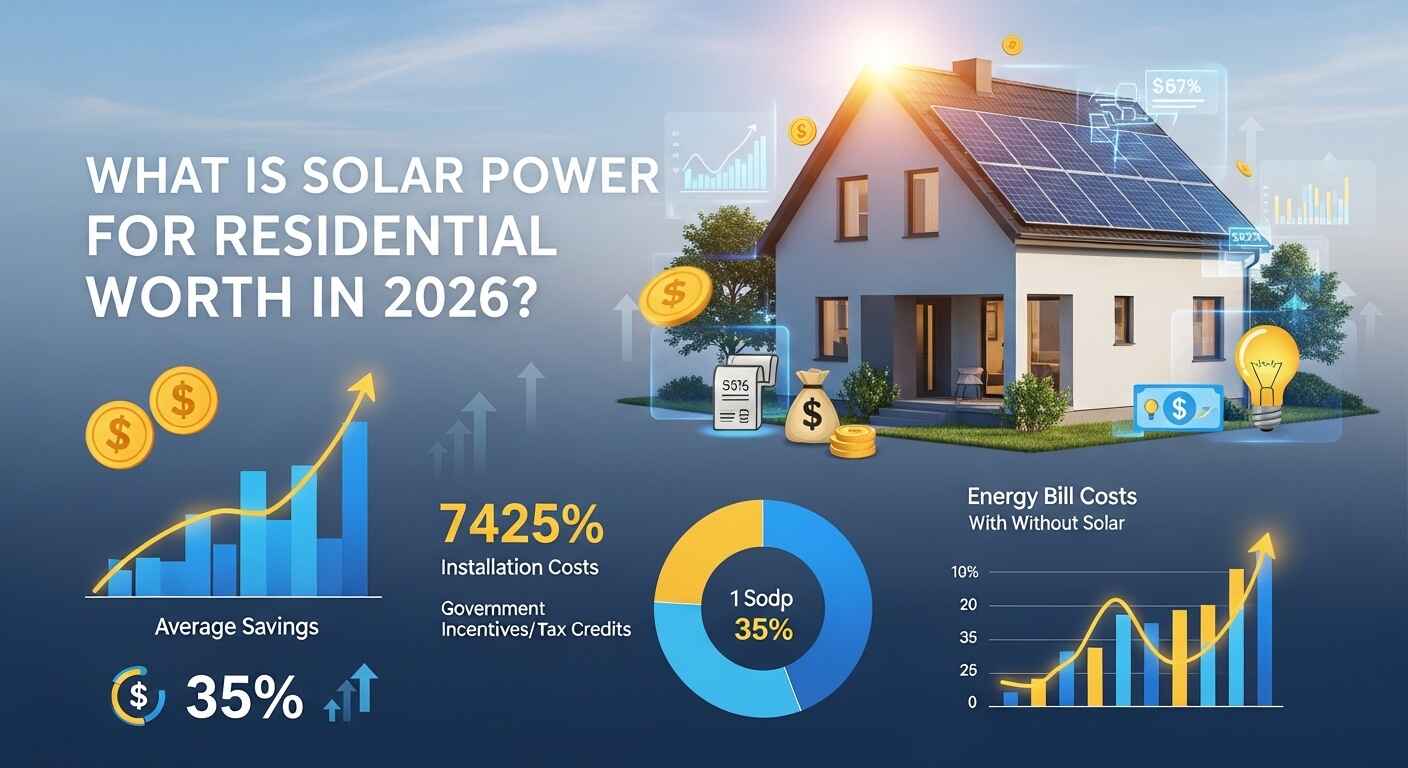
Solar power for residential in the UK costs £6,000–£9,800 for a typical 3–4 bedroom property in 2026, all at 0% VAT. Average savings reach £818–£963 per year when combined with a battery and the Smart Export Guarantee. The payback period runs 10–12 years with battery storage, and households can make over £10,000 profit across a 25-year panel lifespan. Low-income households may qualify for fully funded solar through ECO4 grants extended until December 2026.
Why 2026 Is a Different Conversation for Residential Solar
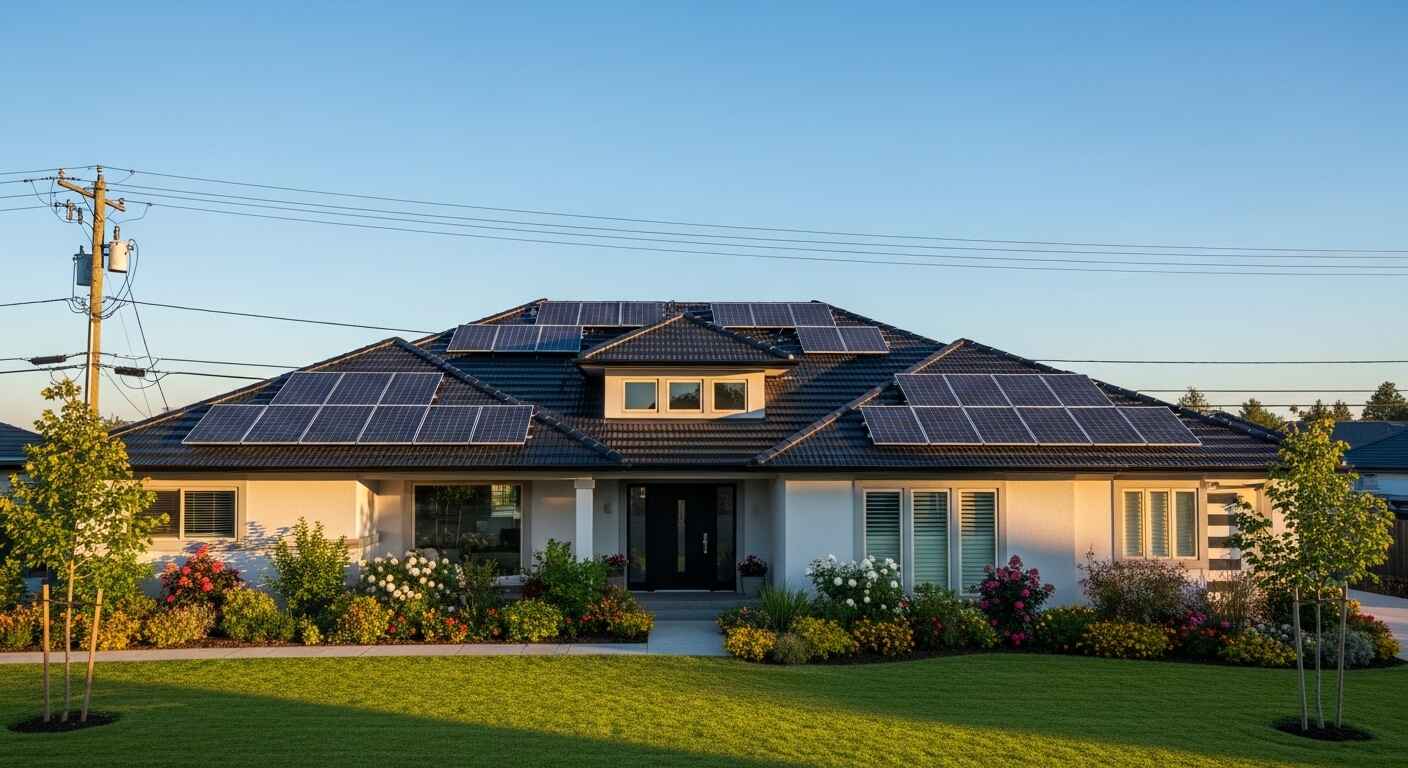
The residential solar power question has shifted significantly in 2026. Three years ago, most UK homeowners debated whether solar was viable. The question now is whether it makes financial sense specifically for their property — because the headline numbers have improved considerably.
Solar panel costs have fallen 2.4% per kilowatt since 2024, reaching their lowest point in nearly two years according to UK government data. The 0% VAT rate continues until March 2027, saving the average three-bedroom household approximately £565 on a combined solar and battery system. The Smart Export Guarantee still pays homeowners 4p–15p for every unit of surplus electricity sent back to the grid.
The honest context: the Ofgem energy price cap for Q2 2026 cut electricity costs by 10.9% and gas by 3.2%, which slightly reduces the immediate savings from generating your own power and extends the payback period by roughly one to two years compared to when prices were higher. That is a real consideration — but it is a temporary one. Energy prices have risen and fallen throughout the last decade, and the long-term trajectory across a 25-year panel lifespan favours homeowners who generate their own power over those who remain entirely grid-dependent.
Key takeaway:
2026 costs are down, grants are still available, and the long-term case for solar power for residential remains strong despite the current lower energy price cap.
How Much Does Residential Solar Power Cost in the UK in 2026?
This is the question most homeowners ask first, and the answer depends on system size. Here is the full breakdown based on April 2026 data:
System Costs by Property Size
| System Size | Property Type | Installed Cost | Includes Battery? |
|---|---|---|---|
| 3kW | 1–2 bed flat/house | £5,000–£6,500 | No |
| 4kW | 3 bed semi/terrace | £6,000–£8,000 | No |
| 4.5kW + 3kW battery | 3 bed house | ~£9,800 | Yes |
| 6kW | 4–5 bed detached | £8,000–£12,000 | No |
All prices include panels, inverter, mounting hardware, and MCS-certified installation. All are currently subject to 0% VAT.
Adding battery storage costs an additional £2,000–£4,000 depending on capacity. A 5kWh battery saves an additional £300–£400 per year by increasing solar self-consumption from roughly 40% to 70–80%. That matters: without a battery, much of the solar power your home generates during the day goes unused if nobody is home.
What the 0% VAT Relief Actually Saves You
Before 2022, solar panels were taxed at 20% VAT. If you had paid full VAT on a £9,800 system, the total would have been £11,760. The zero-rated VAT saves you £1,960 upfront — a meaningful reduction that applies automatically. No application is needed.
For a standard 4kW system at £7,000, the VAT relief saves around £1,400 compared to pre-2022 pricing. This is the UK’s most universally accessible solar incentive because every homeowner qualifies regardless of income.
Key takeaway:
A 3-bed house can go solar with battery storage for approximately £9,800 in 2026 — with no VAT applied.
Solar Power Savings and Returns — The Real Numbers
Understanding whether solar power for residential use is worth it requires calculating both direct savings and income from exported electricity.
Annual Bill Savings
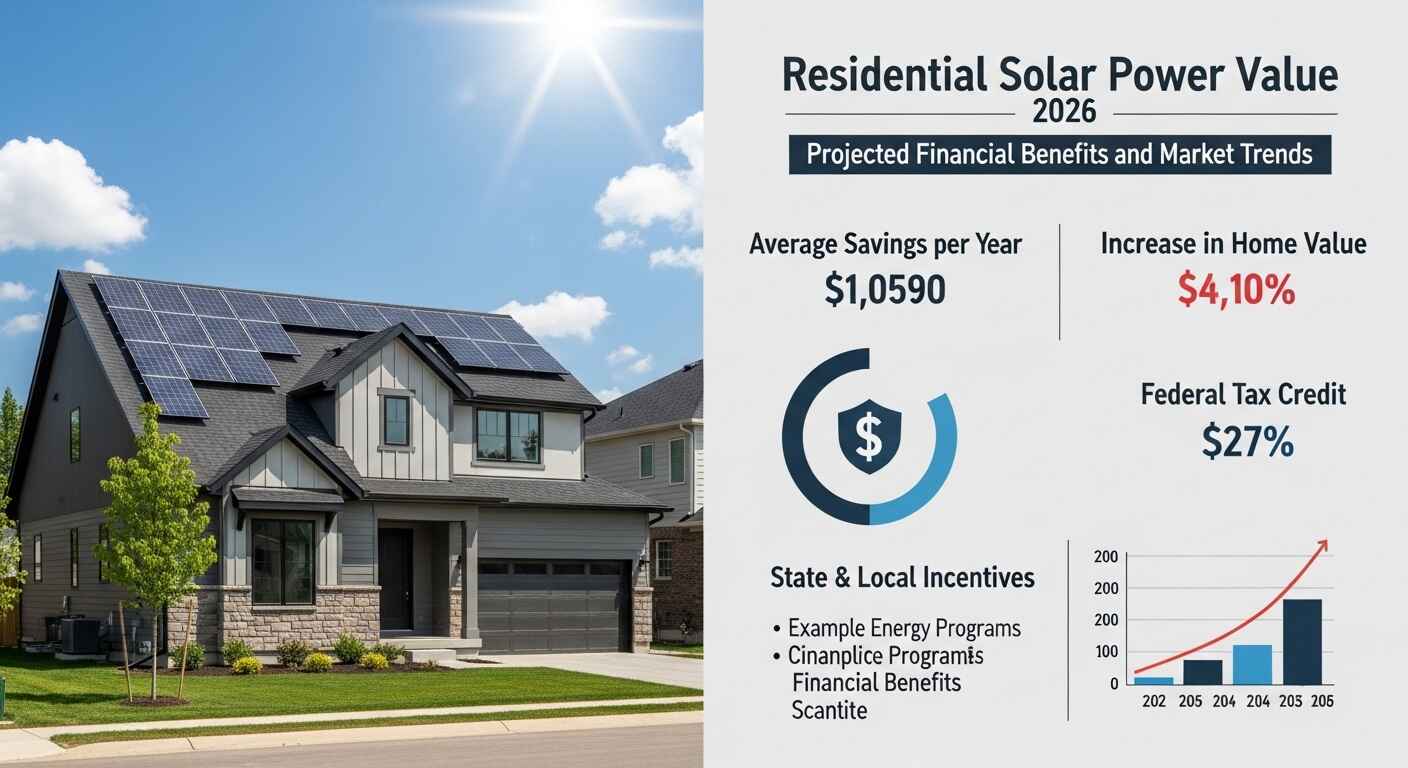
The average UK household saves £1,100 per year with a standard solar setup according to Great British Energy’s 2026 analysis. With a battery added, the Federation of Master Builders’ April 2026 data puts average savings at £818–£963 per year for a 3-bed house, depending on location.
The variation matters. A household in the south of England generates more solar power than one in Scotland — potentially 15–20% more over the course of a year. A south-facing roof at 30–40° pitch maximises output. East- or west-facing roofs still work but generate around 15% less than optimal.
Smart Export Guarantee — Earning from Surplus Power
The Smart Export Guarantee (SEG) replaced the old Feed-in Tariff in 2020 and pays homeowners for every unit of surplus solar electricity exported to the grid. Rates range from 4p to 15p per kWh depending on the energy supplier.
A 4kW system typically exports around 2,000 kWh per year, generating between £80 and £300 annually from SEG payments. This income is on top of direct bill savings. The best SEG rates in 2026 include Octopus Energy’s Outgoing Agile tariff, which pays variable rates that can significantly exceed the standard floor rate.
Note: SEG is not available in Northern Ireland.
The 25-Year Financial Picture
Over a 25-year panel lifespan, the federation’s data suggests a profit of over £10,000 above installation costs for a south-of-England 3-bed house. That calculation assumes:
- An average of £900/year in combined savings and SEG income
- Inflation in energy prices broadly continuing at historic averages
- No major system failures within the warranty period (most quality panels carry a 25-year performance guarantee)
Key takeaway:
Savings and SEG income together justify the investment over the panel lifespan — the question is how long you plan to stay in the property.
Government Grants for Solar Panels UK — What Is Available in 2026
Many homeowners assume grants no longer exist for solar power for residential properties. That is not accurate. The grant landscape has changed but remains substantial.
ECO4 Scheme — Free Solar for Eligible Households
The ECO4 (Energy Company Obligation) scheme covers fully funded solar panel installation for low-income and fuel-poor households. It was extended in January 2026 until December 2026. Managed by Ofgem, the scheme requires larger energy suppliers to fund energy-efficiency measures including solar PV panels for qualifying homes.
Eligibility typically requires:
- Receiving qualifying benefits (Universal Credit, Pension Credit, income-related ESA, etc.)
- Living in a property rated EPC band D, E, F, or G
- Meeting household income thresholds set by your energy supplier
Where approved, the energy company pays the installer directly. If ECO4 does not cover the full cost, you pay the balance directly or through a financing plan. The Solar Together group-buying scheme was the most popular among the 2,000+ homeowners surveyed by the Federation of Master Builders — 28% used it and saved 30–35% compared to private installation.
Warm Homes Plan 2026 — The Biggest Upgrade Programme in British History
The UK Government launched the Warm Homes Plan in January 2026 — a £15 billion programme described as the biggest home upgrade plan in British history. It includes funding for solar installations as part of broader retrofit packages. Specific eligibility criteria and rollout timings are still being finalised at the time of writing, so check gov.uk regularly for updates.
Real case study: Therese, from the North East of England, had her 3.69kW solar system installed through the Warm Homes Local Grant via Newcastle City Council at zero upfront cost. Within six months she had saved over £125 on bills and received a £95 Smart Export Guarantee credit.
0% VAT — The Universal Incentive
Every UK homeowner qualifies for 0% VAT on solar panel installation until March 2027. This does not require any application — your installer applies it automatically. It is the closest thing to a universal solar grant that exists for those who do not qualify for ECO4.
Warm Homes Nest Scheme (Wales)
Welsh homeowners have access to the Nest Scheme, which funds energy-efficiency improvements including solar for qualifying households. Contact the Welsh Government directly for current eligibility criteria.
Local Authority Solar Programmes
Many councils run regional retrofit programmes. Essex County Council’s Solar Together group-buying scheme generated record sign-ups in 2023. Local authority availability varies — contact your council directly to check for active schemes in your area.
Key takeaway:
Free solar through ECO4 remains available until December 2026. All other homeowners get 0% VAT and SEG income as standard. The Warm Homes Plan adds further future opportunity.
Solar Panel and Battery Kit for Home — What You Actually Need
Many homeowners search for solar panel and battery kit options as a single combined purchase. The right system size depends on your household’s energy consumption pattern rather than just property size.
Sizing Your System
The calculation begins with your annual electricity consumption in kilowatt-hours (kWh). The average UK home uses approximately 3,500 kWh per year. A 4kW south-facing system generates 3,400–4,200 kWh annually in the UK — roughly matching that average.
If your household uses significantly more — running an electric vehicle, working from home, or operating an electric heat pump — a 6kW system is worth considering. The additional cost (roughly £2,000–£4,000 more than a 4kW system) pays back through proportionally larger bill reductions.
When to Add Battery Storage
A battery makes sense if:
- You are rarely home during daylight hours (surplus solar power is wasted without storage)
- You want protection against power outages
- You have an electric vehicle and want to charge it using stored solar power at night
- Your SEG rate is low — storing power you use at home avoids buying it at the grid rate, which is more valuable than exporting it at low SEG rates
The Tesla Powerwall is the most recognised battery product in the UK market — a 13.5kWh unit currently costs approximately £8,000 to £10,000 installed. More affordable alternatives from GivEnergy, Growatt, and SolarEdge offer 5–10kWh capacity at £3,000–£6,000 installed.
A 5kWh battery at £3,500 installed saves an additional £300–£400/year compared to panels alone. The payback extends to approximately 8–10 years for the battery component alone, but battery prices continue to fall year-on-year.
Key takeaway:
A 4kW solar system plus 5kWh battery is the most popular home solar power configuration in the UK in 2026 — covering most energy needs at around £9,800 total.
Why Solar Panels Are Not Worth It in Some Cases — The Honest Assessment
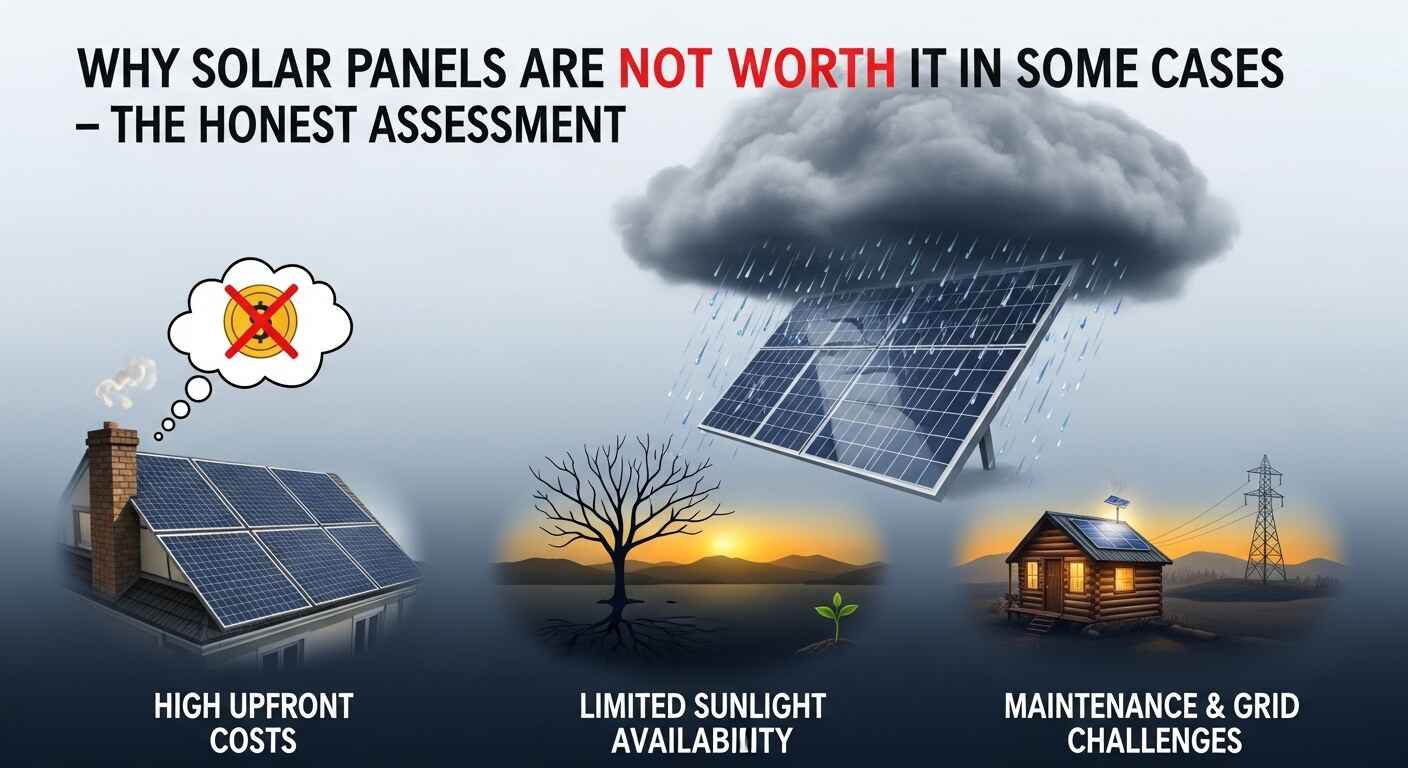
Any article about solar power for residential that only presents the case for installation is not giving you the full picture. Here are the genuine situations where solar may not be the right choice.
Roof Orientation and Shading
North-facing roofs generate significantly less solar power than south-facing ones — in some cases, too little to justify installation costs. Significant shading from trees, chimneys, or neighbouring buildings reduces output further. A qualified MCS surveyor will assess this before recommending a system size.
Short-Term Residence Plans
The payback period for a 4kW system with battery runs 10–12 years. If you plan to sell the property within five years, you may not recoup the installation cost through energy savings alone — though solar panels do add approximately 4–14% to property values according to various UK estate agent surveys, which partially offsets this.
Lower-Income Homeowners Without Grant Eligibility
The 0% VAT helps, but £6,000–£9,800 upfront remains a significant commitment. If you do not qualify for ECO4 or any local authority scheme and cannot access green finance at reasonable rates, waiting for the Warm Homes Plan to clarify its eligibility criteria and funding model may be a better approach than taking on high-interest debt for the installation.
Average Monthly Electric Bill With Solar Panels UK — Realistic Expectations
Many homeowners expect solar to eliminate their electricity bill. It typically does not — at least not without a large battery and a south-facing roof with optimal tilt. A more realistic expectation for a 3-bed house: the electricity bill falls by 40–70% depending on occupancy patterns, with the remainder covered by grid import, particularly in winter when solar output drops.
Average monthly electricity bills with solar panels in the UK run approximately £30–£60 compared to £80–£120 without solar for equivalent properties — a meaningful reduction, but not elimination.
Key takeaway:
Solar is not the right choice for every property, timeline, or financial situation. An honest assessment of your roof, tenure plans, and grant eligibility comes before any financial commitment.
Solar and Wind Power for Residential Homes — Beyond PV Panels
Solar photovoltaic panels are the dominant residential renewable technology in the UK. Small-scale domestic wind turbines exist but face significant planning restrictions in urban and suburban areas, generate less predictably than solar, and require more maintenance.
For homeowners interested in solar and wind power for residential use together, the practical reality is that wind makes sense primarily for rural properties with consistently strong average wind speeds — typically properties outside urban areas with sufficient land for turbine siting.
For most UK residential homes, solar PV with battery storage is the correct renewable energy investment. The addition of a heat pump — converting from gas central heating to electricity-powered heating — amplifies the financial return from solar generation significantly, since the heat pump runs on the electricity your panels generate.
The combination of solar panels + battery storage + heat pump represents the residential renewable stack that the UK government’s Warm Homes Plan is designed to encourage. Getting these three components installed together is likely to become more financially accessible as the plan’s implementation develops.
Key takeaway:
For most residential homes, solar PV is the right starting point. Wind power makes sense only for specific rural locations. A heat pump alongside solar maximises overall renewable energy savings.
Real Scenario: Is Solar Power Worth It for a 3-Bed House in Leeds?
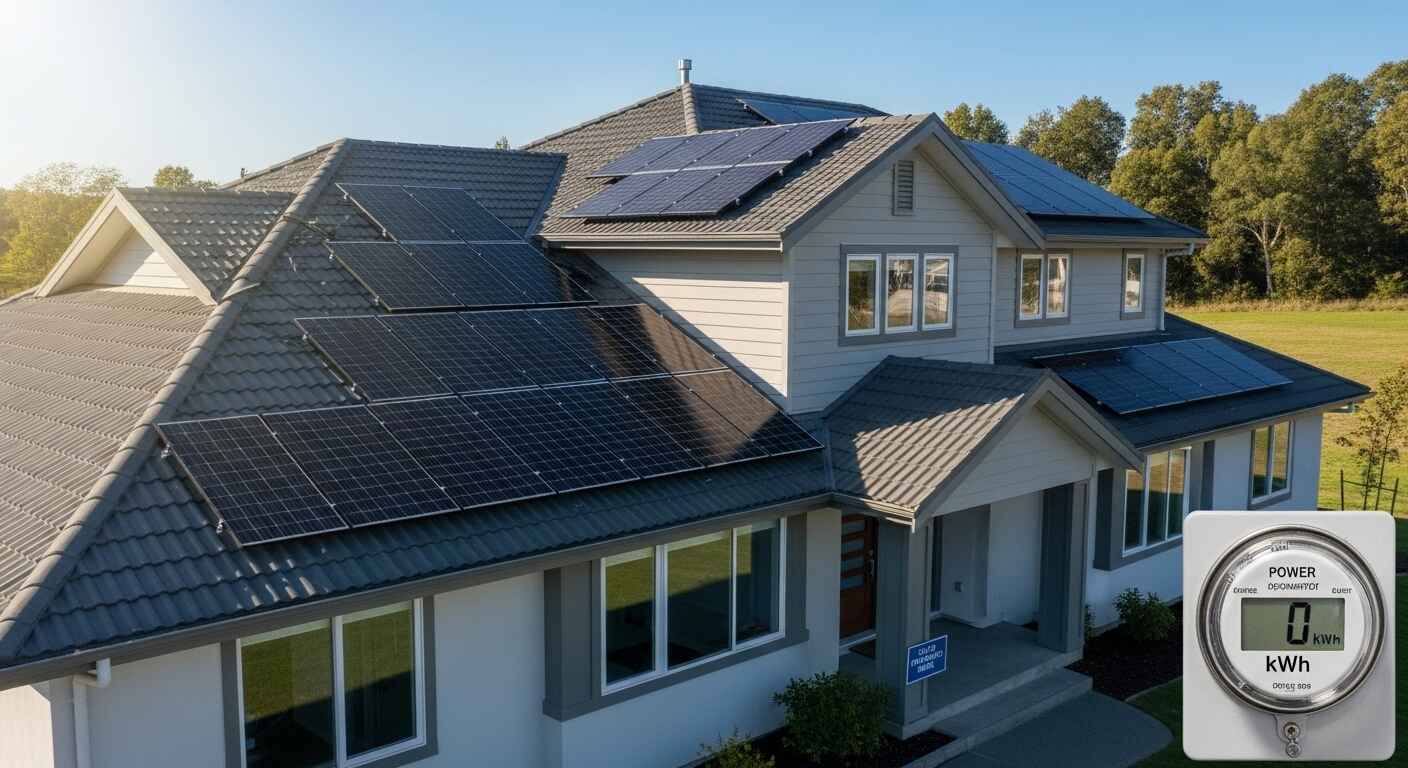
A homeowner in Leeds, West Yorkshire is considering solar power for their residential property. The house is semi-detached, three-bedroom, with a south-southwest facing roof. They currently pay approximately £1,400 per year on electricity.
System quote received:
4kW solar system + 5kWh battery, installed at £9,600 including 0% VAT. The installer is MCS-certified.
ECO4 eligibility:
The homeowner is not receiving qualifying benefits and earns above the income threshold. ECO4 is not available.
Projected savings:
Based on location (West Yorkshire generates approximately 15–20% less solar than southern England), the installer estimates £750–£850/year in combined savings and SEG income. Optimistic estimate: £850/year.
Payback calculation:
£9,600 ÷ £850 = approximately 11.3 years.
25-year outcome:
After 11.3 years of cost recovery, 13.7 remaining years at £850/year = approximately £11,645 total profit above installation cost.
The decision:
For a homeowner planning to stay in the property long-term, the investment is justified — particularly given that energy prices will not remain at current lower levels indefinitely. The Ofgem price cap reduction in Q2 2026 is a short-term improvement, not a permanent shift. Locking in protection from future energy price rises by generating your own power adds value beyond the calculated savings figure.
The caveat:
If this homeowner planned to sell within five to seven years, the calculation changes. Solar panels may add some property value but probably not enough to fully recover costs in that timeframe without strong capital appreciation. In that scenario, waiting or exploring a subscription model (paying monthly rather than upfront) would be more appropriate.
FAQs
Is solar power for residential worth it in the UK in 2026?
For most homeowners planning to stay in their property for 12 or more years, yes. A 4kW system with battery costs around £9,800 at 0% VAT, saves £818–£963 per year through reduced bills and Smart Export Guarantee income, and generates over £10,000 profit across a 25-year lifespan. Low-income households may qualify for free installation through ECO4. The current lower Ofgem price cap slightly extends the payback period but does not change the long-term case.
What government grants are available for solar panels in the UK in 2026?
The ECO4 scheme (extended until December 2026) offers fully funded solar installation for low-income households on qualifying benefits with EPC ratings of D–G. The Warm Homes Plan launched in January 2026 provides additional retrofit funding including solar, with specific eligibility criteria still being confirmed. All homeowners receive 0% VAT on solar installations until March 2027 — saving approximately £1,400 on a typical 4kW system. Local authority schemes vary by region.
How much does solar power for residential cost in the UK?
A 4kW solar system costs £6,000–£8,000 installed in 2026. Adding a 5kWh battery brings the total to approximately £9,800 for a 3-bedroom home. All installations are VAT-free until March 2027. Larger 6kW systems range from £8,000 to £12,000. The government’s £15 billion Warm Homes Plan may fund installations for eligible households. Always get at least three quotes from MCS-certified installers before committing.
What is the Smart Export Guarantee and how much does it pay?
The Smart Export Guarantee (SEG) is the government scheme that requires energy suppliers to pay homeowners for surplus solar electricity exported to the grid. Rates range from 4p to 15p per kWh depending on the supplier. A typical 4kW system exports around 2,000 kWh per year, earning £80–£300 annually. SEG is not available in Northern Ireland. Octopus Energy and other forward-leaning suppliers offer competitive rates.
Are solar panels worth it in the UK given the cloudy weather?
Yes — modern solar panels operate in diffuse light, not just direct sunlight. A south-facing 4kW UK system still generates 3,400–4,200 kWh per year, covering the average UK household’s annual electricity consumption. Output is lower in Scotland than in southern England, and winter months produce significantly less than summer months. A battery helps capture and store summer daytime generation for use in the evenings. Weather-related concerns are the most common reason homeowners hesitate on solar in the UK — they are also the most overstated.
What is the payback period for residential solar panels in the UK?
The payback period for solar panels without a battery runs 6–8 years in 2026. With battery storage, it extends to 10–12 years. After payback, electricity from your panels is essentially free for the remaining warranty period. The 25-year profit above installation costs exceeds £10,000 for a typical 3-bedroom south-of-England property. Location, roof orientation, and household occupancy patterns all affect the actual payback calculation.
Solar power for residential in the UK is a genuine long-term financial investment in 2026 — not a lifestyle statement. The 0% VAT rate, ECO4 grants for eligible households, Smart Export Guarantee income, and falling system costs have collectively made residential solar more accessible than at any point in the UK’s renewable energy history.
The honest assessment: it works best for homeowners who plan to stay in their property for over 12 years, have a south- or south-west-facing roof with minimal shading, and can either fund the installation upfront or access green finance at reasonable rates. For low-income households, ECO4 removes the cost entirely until December 2026.
The specific action to take today: check your ECO4 eligibility first (it takes under five minutes through any major energy supplier’s website). If you qualify, the entire cost of solar power for residential use could be funded at zero cost to you. If you do not qualify, request at least three quotes from MCS-certified installers and use the Solar Together group-buying scheme if your local council participates — it consistently delivers 30–35% savings over private installation.