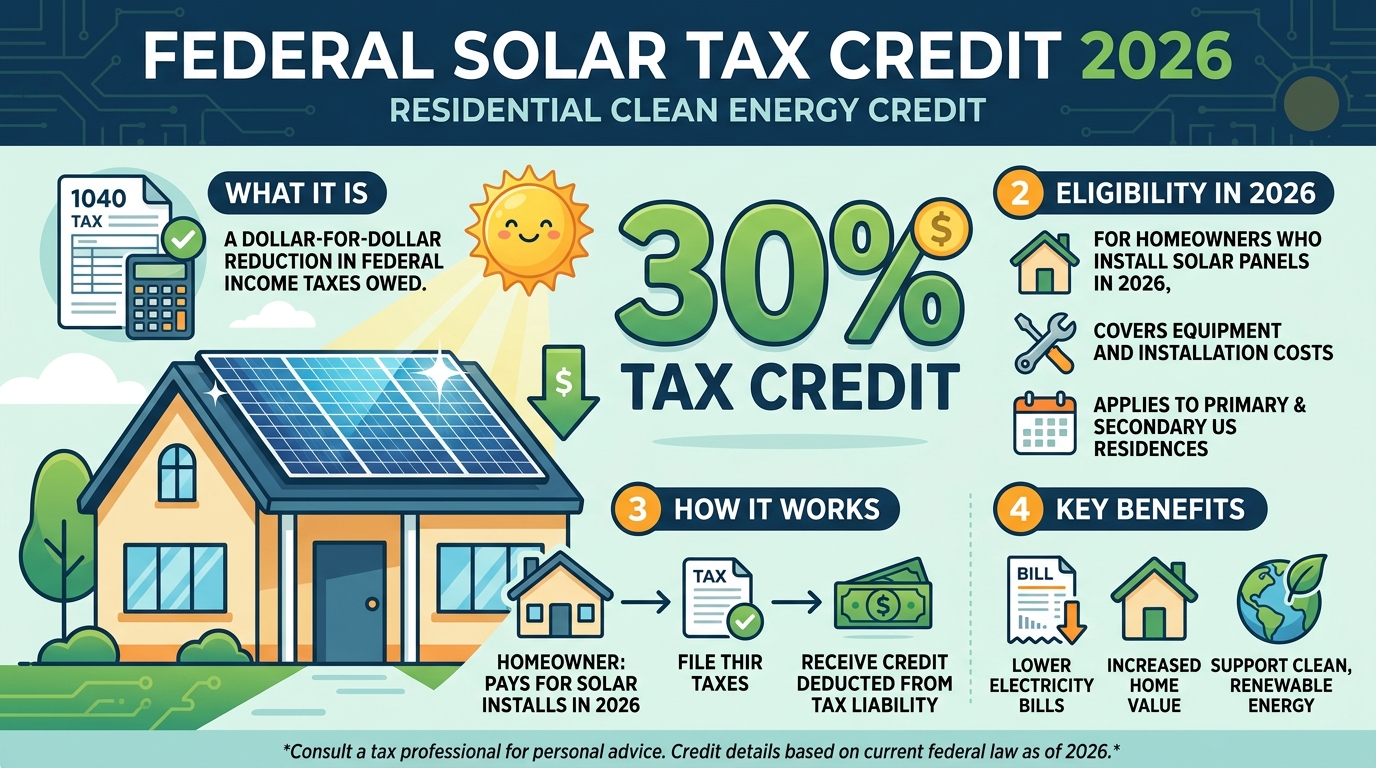
Introduction: Why the Solar Tax Credit 2026 Matters More Than Ever
Are you thinking about going solar in 2026? Here’s the exciting news — the federal solar tax credit in 2026 is still worth a massive 30% of your total solar installation cost. That means if you spend $30,000 on a solar panel system, the government hands you back $9,000 as a dollar-for-dollar tax credit.
But here’s what most people don’t realize: the solar tax credit won’t stay at 30% forever. Starting in 2033, the credit begins to step down, and by 2035, it could disappear entirely for residential installations. That makes 2026 one of the best years to take advantage of this incredible tax benefit.
In this complete guide, we’ll walk you through everything you need to know about the solar tax credit in 2026 — including how much you can save, who qualifies, how to claim it on your taxes, what expenses are covered, and the critical deadlines you can’t afford to miss.
Whether you’re a homeowner, small business owner, or someone simply curious about solar energy savings, this guide will show you exactly how to maximize your solar tax credit and save up to $10,000 or more in 2026.
💡 Quick Fact: The average American homeowner saves between $6,000 and $12,000 through the federal solar tax credit. Some homeowners save even more when combining federal and state incentives.
Let’s dive into everything you need to know.
What Is the Solar Tax Credit?
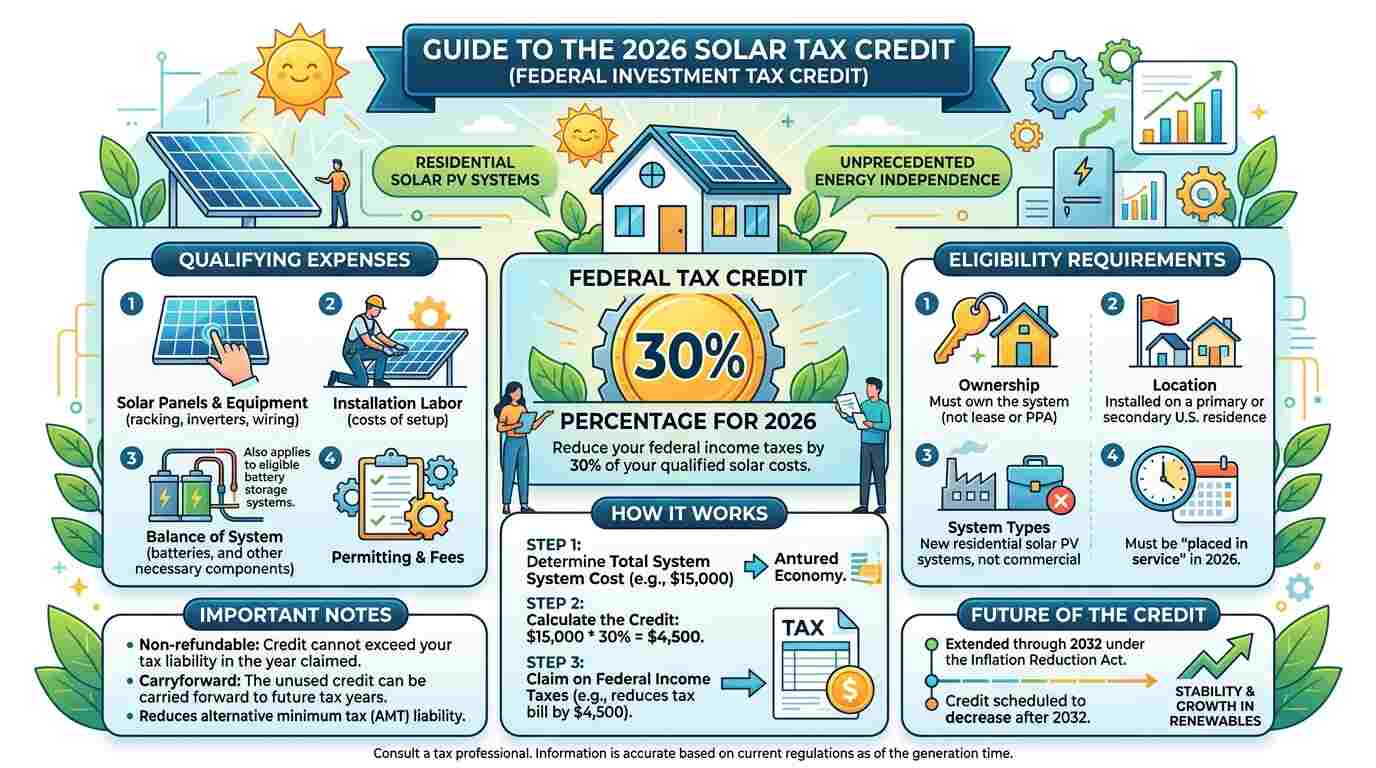
The solar tax credit — officially known as the Residential Clean Energy Credit (formerly the Investment Tax Credit or Solar ITC) — is a federal tax incentive that allows homeowners and businesses to deduct a percentage of their solar energy system costs from their federal income taxes.
This isn’t a tax deduction — it’s a tax credit, which means it reduces your tax bill dollar for dollar. If you owe $8,000 in federal taxes and have a $9,000 solar tax credit, your tax liability drops to $0, and the remaining $1,000 rolls forward to next year.
Key Facts About the Solar Tax Credit 2026
| Feature | Details |
|---|---|
| Official Name | Residential Clean Energy Credit (Section 25D) |
| Credit Percentage in 2026 | 30% of total qualified costs |
| Maximum Credit Amount | No cap — based on system cost |
| Credit Type | Dollar-for-dollar federal tax credit |
| Refundable? | No — but unused credit rolls forward |
| Who Qualifies? | U.S. homeowners with federal tax liability |
| Applicable To | Solar panels, battery storage, installation labor |
| IRS Form | Form 5695 (Residential Energy Credits) |
How Much Is the Solar Tax Credit in 2026?
The solar tax credit in 2026 is 30% of your total eligible solar installation costs. This rate was locked in by the Inflation Reduction Act (IRA) of 2022, which extended and enhanced the solar tax credit through 2032.
Solar Tax Credit Rate Timeline (2022–2035)
| Year | Tax Credit Rate | Status |
|---|---|---|
| 2022 | 30% | ✅ Active |
| 2023 | 30% | ✅ Active |
| 2024 | 30% | ✅ Active |
| 2025 | 30% | ✅ Active |
| 2026 | 30% | ✅ Current Year |
| 2027 | 30% | ✅ Scheduled |
| 2028 | 30% | ✅ Scheduled |
| 2029 | 30% | ✅ Scheduled |
| 2030 | 30% | ✅ Scheduled |
| 2031 | 30% | ✅ Scheduled |
| 2032 | 30% | ✅ Last year at 30% |
| 2033 | 26% | ⚠️ Step-down begins |
| 2034 | 22% | ⚠️ Further reduction |
| 2035 | 0% (residential) | ❌ Expires for homeowners |
⚠️ Important: While the 30% rate is stable through 2032, political and legislative changes could alter this timeline. Installing solar in 2026 locks in your 30% credit regardless of future policy changes.
Solar Tax Credit 2026 Savings Calculator
Here’s how much you could save based on common solar system costs:
| Solar System Cost | 30% Tax Credit Value | Your Net Cost |
|---|---|---|
| $15,000 | $4,500 | $10,500 |
| $20,000 | $6,000 | $14,000 |
| $25,000 | $7,500 | $17,500 |
| $30,000 | $9,000 | $21,000 |
| $35,000 | $10,500 | $24,500 |
| $40,000 | $12,000 | $28,000 |
| $50,000 | $15,000 | $35,000 |
💰 Real Example: The average residential solar installation in the U.S. costs approximately $31,000 before incentives. At the 30% credit rate, that’s a federal tax credit of $9,300 — bringing your effective cost down to $21,700.
Who Qualifies for the Solar Tax Credit in 2026?
Not everyone can claim the solar tax credit. Here are the eligibility requirements you must meet:
Eligibility Requirements
- You must own the solar panel system leased systems and power purchase agreements (PPAs) do NOT qualify
- The system must be installed on your U.S. property — primary residence, secondary home, or new construction
- The system must be new or used for the first time — you must be the original installer
- You must have federal tax liability — the credit reduces your tax bill, so you need to owe taxes
- The system must be installed and operational during the tax year you’re claiming the credit
- The property must be located in the United States — including Puerto Rico and U.S. territories
Who Does NOT Qualify?
| Situation | Eligible? |
|---|---|
| You own solar panels on your primary home | ✅ Yes |
| You own solar panels on your second home | ✅ Yes |
| You own solar panels on a new construction home you’re building | ✅ Yes |
| You lease solar panels | ❌ No |
| You have a solar PPA (Power Purchase Agreement) | ❌ No |
| You installed solar on a rental property you own | ❌ No (residential credit) — but may qualify for business credit |
| You live in a condo and your HOA installed solar | ⚠️ Partial — proportional share may qualify |
| You installed solar on a property outside the U.S. | ❌ No |
Income Limits — Good News!
There are NO income limits for the federal solar tax credit in 2026. Whether you earn $50,000 or $500,000 per year, you qualify for the full 30% credit. This is one of the few tax incentives available to all income levels.
What Expenses Does the Solar Tax Credit Cover?
The 30% federal solar tax credit covers more than just solar panels. Here’s a comprehensive list of qualified expenses in 2026:
Qualified Expenses (Eligible for 30% Credit)
- ☀️ Solar photovoltaic (PV) panels — the panels themselves
- 🔋 Battery storage systems — with capacity of 3 kWh or greater (new addition from IRA)
- ⚡ Inverters — string inverters and microinverters
- 🔌 Wiring and electrical components — necessary for system operation
- 🏗️ Installation labor costs — contractor labor for installation
- 📐 Mounting hardware and racking — roof mounts and ground mounts
- 📊 Energy monitoring systems — if included with solar installation
- 🏠 Roof reinforcement — if specifically required for solar panel installation
- 📋 Permitting fees — local permit costs for solar installation
- 🔍 Inspection costs — required inspections for system approval
- 💼 Sales tax on solar equipment — if applicable in your state
- 🔄 Balance of system components — conduit, disconnects, breakers
Non-Qualified Expenses (NOT Eligible)
- ❌ Roof replacement (unless specifically for solar structural support)
- ❌ Landscaping or tree removal
- ❌ General home improvements
- ❌ Grid connection fees charged by utility companies
- ❌ Extended warranty costs purchased separately
- ❌ Maintenance or cleaning services
Battery Storage — Newly Eligible!
One of the biggest improvements from the Inflation Reduction Act is that standalone battery storage systems now qualify for the 30% tax credit, even if they’re installed without solar panels. Previously, batteries had to be paired with solar to qualify.
🔋 Pro Tip: Adding a battery like the Tesla Powerwall ($12,000–$16,000) to your solar system means an additional $3,600–$4,800 in tax credits — on top of your solar panel credit.
How to Claim the Solar Tax Credit in 2026: Step-by-Step Guide
Claiming the federal solar tax credit is straightforward if you follow these steps carefully:
Step 1: Install Your Solar System
- Choose a qualified solar installer
- Ensure the system is installed and operational before December 31, 2026
- The system must be placed “in service” during the 2026 tax year
Step 2: Gather Your Documentation
Collect the following documents after installation:
- Purchase contract/agreement showing total system cost
- Receipts and invoices for all equipment and labor
- Manufacturer certifications for solar panels and components
- Proof of installation completion — final inspection report
- Interconnection agreement with your utility company
- Photos of installed system (recommended for records)
Step 3: Complete IRS Form 5695
When filing your 2026 federal tax return, you’ll need to complete IRS Form 5695 — Residential Energy Credits:
- Part I — Calculate your Residential Clean Energy Credit
- Enter the total cost of your solar energy system
- Multiply by 30% (0.30) to determine your credit amount
- Transfer the credit amount to your Form 1040, Schedule 3
Step 4: File Your Tax Return
- Include Form 5695 with your federal tax return
- The credit will be applied to Line 5 of Schedule 3
- This reduces your total tax liability on Form 1040
Step 5: Roll Forward Any Unused Credit
If your tax credit exceeds your tax liability for 2026, the remaining credit carries forward to future tax years. For example:
| Scenario | Amount |
|---|---|
| Your solar tax credit | $9,000 |
| Your 2026 federal tax liability | $6,000 |
| Credit used in 2026 | $6,000 |
| Credit rolled forward to 2027 | $3,000 |
📝 Important: The solar tax credit is non-refundable, meaning it can reduce your tax bill to $0 but won’t generate a refund on its own. However, the carry-forward provision ensures you don’t lose any unused credit.
Solar Tax Credit 2026 vs. Previous Years
What Changed From 2025 to 2026?
The good news: nothing significant changed between 2025 and 2026 regarding the solar tax credit rate. The credit remains at 30% thanks to the Inflation Reduction Act.
| Feature | 2024 | 2025 | 2026 |
|---|---|---|---|
| Credit Rate | 30% | 30% | 30% |
| Battery Storage Eligible | Yes | Yes | Yes |
| Income Limits | None | None | None |
| Credit Cap | None | None | None |
| Carry Forward | Yes | Yes | Yes |
| Standalone Battery | Yes | Yes | Yes |
| Made-in-America Bonus | Varies | Varies | Varies |
Solar Tax Credit 2026 vs. 2033 — Why Install NOW
| Factor | 2026 | 2033 |
|---|---|---|
| Credit Rate | 30% | 26% |
| On $30,000 system | $9,000 back | $7,800 back |
| Difference | — | $1,200 less |
| Solar panel prices | Current market | Potentially higher due to inflation |
| Energy savings | Start saving NOW for 7+ years | Delayed savings |
State Solar Tax Credits & Incentives (Stack With Federal Credit)
One of the best strategies for maximizing savings is stacking your federal solar tax credit with state and local incentives. Many states offer additional credits, rebates, and incentives on top of the federal 30%.
Top States for Solar Incentives in 2026
| State | State Incentive | Combined With Federal 30% |
|---|---|---|
| California | Net metering + SGIP battery rebate | Up to 40%+ total savings |
| New York | 25% state tax credit (up to $5,000) | Up to 55% total savings |
| Massachusetts | SMART program + net metering | Up to 45%+ total savings |
| New Jersey | SRECs (Solar Renewable Energy Credits) | Up to 50%+ total savings |
| Texas | Property tax exemption + net metering | 30% + property tax savings |
| Florida | Sales tax exemption + property tax exemption | 30% + tax exemptions |
| Arizona | 25% state tax credit (up to $1,000) | 30% federal + state credit |
| Colorado | Net metering + utility rebates | Up to 40%+ total savings |
| Maryland | $1,000 state grant + property tax exemption | 30% + $1,000 grant |
| Illinois | SREC program + Adjustable Block Program | Up to 50%+ total savings |
💡 Pro Tip: Some states offer additional incentives for battery storage, low-income households, or community solar projects. Check your state’s energy office website or the DSIRE database (dsireusa.org) for a complete list.
Common Mistakes to Avoid When Claiming the Solar Tax Credit
Mistake #1: Missing the December 31 Deadline
Your solar system must be installed and operational by December 31, 2026, to claim the credit on your 2026 taxes. Don’t wait until November to start the process — solar installations can take 6-12 weeks from contract signing to completion.
Mistake #2: Leasing Instead of Buying
If you lease your solar panels or sign a Power Purchase Agreement (PPA), the solar company — not you — claims the tax credit. To get the full 30% benefit, you must own the system outright (cash purchase or solar loan).
Mistake #3: Not Including All Eligible Costs
Many homeowners forget to include costs like:
- Installation labor
- Permitting fees
- Sales tax on equipment
- Battery storage costs
- Electrical upgrades required for installation
Include everything — the larger your total qualified cost, the bigger your tax credit.
Mistake #4: Not Having Enough Tax Liability
The solar tax credit is non-refundable. If your federal tax bill is only $3,000 but your credit is $9,000, you’ll only use $3,000 in the first year. The remaining $6,000 carries forward, but it takes longer to fully benefit.
Solution: Consider timing strategies — if you have a high-income year expected, install solar that year to maximize immediate credit use.
Mistake #5: Forgetting to File Form 5695
The credit is not automatic. You must actively claim it by filing IRS Form 5695 with your federal tax return. Many homeowners miss this step and leave thousands on the table.
Mistake #6: Installing on a Rental Property
The Residential Clean Energy Credit applies to your primary or secondary home — not rental or investment properties. Rental property owners may qualify for the commercial solar tax credit instead (Section 48).
Mistake #7: Not Keeping Documentation
Keep all receipts, contracts, invoices, and installation documents for at least 7 years after claiming the credit. The IRS can audit solar tax credit claims, and you’ll need documentation to support your claim.
Solar Tax Credit for Business Owners in 2026
Business owners have a separate but equally valuable solar tax credit option:
Commercial Solar Investment Tax Credit (ITC) — Section 48
| Feature | Residential (Section 25D) | Commercial (Section 48) |
|---|---|---|
| Base Credit Rate | 30% | 30% (with prevailing wage & apprenticeship) |
| Without Wage Requirements | N/A | 6% (base rate) |
| Domestic Content Bonus | N/A | Additional 10% |
| Energy Community Bonus | N/A | Additional 10% |
| Maximum Possible | 30% | Up to 50% |
| Depreciation | No | Yes (MACRS 5-year) |
🏢 Business Owner Tip: Commercial solar installations can qualify for accelerated depreciation (MACRS) in addition to the tax credit, potentially offsetting 85% or more of the total system cost in the first year.
Solar Panel Cost Trends in 2026
Understanding current solar costs helps you estimate your tax credit value:
Average Solar Installation Costs by System Size (2026)
| System Size | Average Cost (Before Credit) | 30% Tax Credit | Net Cost After Credit |
|---|---|---|---|
| 4 kW (Small) | $12,000 – $16,000 | $3,600 – $4,800 | $8,400 – $11,200 |
| 6 kW (Medium) | $18,000 – $24,000 | $5,400 – $7,200 | $12,600 – $16,800 |
| 8 kW (Average) | $24,000 – $32,000 | $7,200 – $9,600 | $16,800 – $22,400 |
| 10 kW (Large) | $30,000 – $40,000 | $9,000 – $12,000 | $21,000 – $28,000 |
| 12 kW (XL) | $36,000 – $48,000 | $10,800 – $14,400 | $25,200 – $33,600 |
Average Cost Per Watt by State (2026)
| State | Avg. Cost Per Watt | 8kW System Cost | Tax Credit (30%) |
|---|---|---|---|
| California | $2.80 | $22,400 | $6,720 |
| Texas | $2.60 | $20,800 | $6,240 |
| Florida | $2.70 | $21,600 | $6,480 |
| New York | $3.20 | $25,600 | $7,680 |
| Arizona | $2.50 | $20,000 | $6,000 |
| Colorado | $3.00 | $24,000 | $7,200 |
| New Jersey | $2.90 | $23,200 | $6,960 |
| Massachusetts | $3.30 | $26,400 | $7,920 |
| Illinois | $3.10 | $24,800 | $7,440 |
| North Carolina | $2.60 | $20,800 | $6,240 |
Solar Tax Credit 2026 Timeline: Key Dates You Must Know
| Date | Action Required |
|---|---|
| January – March 2026 | Best time to get solar quotes and compare installers |
| April – June 2026 | Ideal installation window (before summer demand peak) |
| July – September 2026 | Still time to install — allow 8-12 weeks for completion |
| October 2026 | Last comfortable window to start the process |
| November 2026 | Urgent — contact installer immediately if you haven’t started |
| December 31, 2026 | DEADLINE — System must be installed and operational |
| January – April 2027 | File 2026 taxes and claim credit using Form 5695 |
⏰ Don’t Wait: Solar installations can take 6-12 weeks from contract to completion. If you want to claim the credit for 2026, start the process no later than October 2026.
How to Maximize Your Solar Tax Credit in 2026
Strategy 1: Buy Instead of Lease
Purchasing your solar system (with cash or a solar loan) ensures YOU receive the full 30% tax credit. Leasing transfers the credit to the leasing company.
Strategy 2: Add Battery Storage
Adding a battery system like Tesla Powerwall, Enphase IQ Battery, or LG RESU increases your total system cost and therefore your tax credit. A $15,000 battery adds $4,500 to your credit.
Strategy 3: Include All Eligible Costs
Make sure your installer’s invoice itemizes all qualified expenses including:
- Equipment costs
- Labor costs
- Permitting fees
- Sales tax
- Structural upgrades for installation
Strategy 4: Stack Federal + State Incentives
Combine the 30% federal credit with your state’s incentives. In some states, you can save 50% or more on your total solar installation cost.
Strategy 5: Time Your Installation Strategically
If you expect a higher income in 2026, install solar this year to maximize the credit’s impact against a larger tax liability.
Strategy 6: Consider a Solar Loan
Solar loans allow you to go solar with $0 down while still claiming the full 30% tax credit. Use the credit to pay down the loan principal, reducing your overall financing costs.
Strategy 7: Get Multiple Quotes
Getting 3-5 quotes from different solar installers can save you $2,000–$5,000 on your system cost. Lower cost = lower out-of-pocket even after the credit.
Solar Tax Credit and Home Value
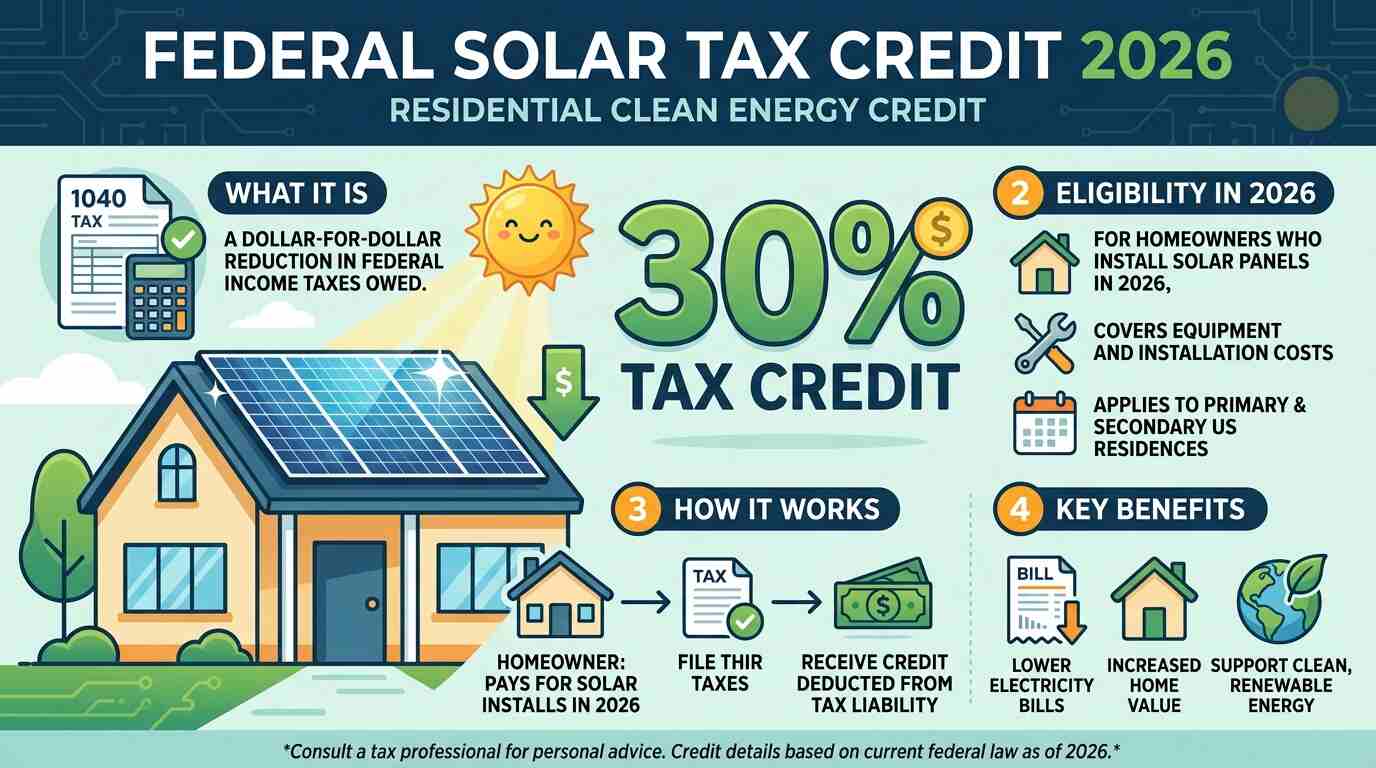
Installing solar panels doesn’t just save you money on taxes and electricity — it also increases your home value:
| Factor | Impact |
|---|---|
| Average home value increase | $15,000 – $25,000 for a typical solar system |
| Sale price premium | Homes with solar sell for 4.1% more on average (Zillow) |
| Buyer preference | 80% of home buyers consider solar panels a desirable feature |
| Property tax impact | Many states exempt solar from property tax assessments |
| Speed of sale | Solar homes sell 20% faster than non-solar homes |
FAQs
Is the solar tax credit still available in 2026?
Yes! The federal solar tax credit is absolutely still available in 2026 at the full 30% rate. Thanks to the Inflation Reduction Act of 2022, the 30% credit is locked in through 2032. You can claim this credit on any qualified solar energy system installed and operational during the 2026 tax year.
How much is the solar tax credit worth in 2026?
The solar tax credit in 2026 is worth 30% of your total qualified solar installation costs. For the average U.S. solar installation costing approximately $30,000, the credit is worth $9,000. There is no maximum cap on the credit amount.
Is there an income limit for the solar tax credit?
No. There are absolutely no income limits or income phase-outs for the federal solar tax credit in 2026. Homeowners at all income levels qualify for the full 30% credit, as long as they meet the other eligibility requirements.
Can I claim the solar tax credit if I finance my solar panels?
Yes! If you purchase your solar system with a solar loan, you can still claim the full 30% federal tax credit. The credit is based on the total system cost, regardless of how you pay for it. However, if you lease solar panels or enter a PPA, you do NOT qualify for the credit.
Can I claim the solar tax credit on a second home?
Yes. The Residential Clean Energy Credit can be claimed on both your primary residence and a second/vacation home. However, it cannot be claimed on rental or investment properties under the residential credit (Section 25D).
What happens if my tax credit is more than my tax bill?
If your solar tax credit exceeds your federal tax liability, the unused portion carries forward to future tax years. The credit can continue to roll forward until it’s fully used. You won’t lose any of the credit — it just takes longer to fully benefit.
Does the solar tax credit apply to battery storage?
Yes! Since the Inflation Reduction Act of 2022, standalone battery storage systems with a capacity of 3 kWh or greater qualify for the 30% tax credit — even without solar panels. This includes popular batteries like Tesla Powerwall, Enphase IQ Battery, and LG RESU.
When does the solar tax credit expire?
The 30% solar tax credit is available through December 31, 2032. After that, it steps down to 26% in 2033, 22% in 2034, and expires entirely for residential installations in 2035 (unless Congress extends it again).
How do I file for the solar tax credit?
To claim the solar tax credit, complete IRS Form 5695 (Residential Energy Credits) and include it with your federal tax return. The credit amount transfers to Schedule 3, Line 5 of your Form 1040.
Can I claim the solar tax credit if I already installed solar in a previous year?
The solar tax credit applies to the year your system was installed and placed in service. If you installed solar in 2025, you’d claim it on your 2025 tax return. You cannot retroactively claim the credit for a different tax year. However, if you have unused credit carrying forward from a prior year, you can use it on your 2026 return.
Do solar panels increase my property taxes?
In many states, no. Numerous states have enacted property tax exemptions for solar energy systems, meaning your property value increase from solar doesn’t result in higher property taxes. Check your state’s specific laws.
Can I claim both federal and state solar tax credits?
Yes! You can absolutely stack the federal solar tax credit with any state tax credits, rebates, or incentives. However, some state incentives may reduce your federal credit basis. Consult a tax professional for specific state-by-state guidance.
Is the solar tax credit a refund or a credit?
The solar tax credit is a non-refundable tax credit. It reduces your federal tax liability dollar-for-dollar but will not generate a refund on its own. If you owe $5,000 in taxes and have a $9,000 credit, your tax bill goes to $0, and the remaining $4,000 carries forward.
What IRS form do I need for the solar tax credit?
You need IRS Form 5695 — Residential Energy Credits. This form calculates your credit amount and transfers it to Schedule 3 of your Form 1040.
How long does it take to install solar panels?
The typical solar installation process takes 6-12 weeks from contract signing to system activation. This includes:
- Site survey: 1-2 weeks
- Design and permitting: 2-4 weeks
- Installation: 1-3 days
- Inspection and utility approval: 1-3 weeks
Final Thoughts: Should You Go Solar in 2026?
The solar tax credit in 2026 represents one of the most valuable tax incentives available to American homeowners. With a guaranteed 30% credit, no income limits, no cap on credit amount, and the ability to carry forward unused credits — there has never been a better time to invest in solar energy.
Here’s a quick summary of why 2026 is an ideal year to go solar:
✅ Reasons to Go Solar in 2026
- 30% federal tax credit — save thousands on your taxes
- No income limits — everyone qualifies
- Battery storage now eligible — maximize your energy independence
- Rising electricity costs — lock in low energy costs for 25+ years
- Increased home value — add $15,000–$25,000 to your property value
- State incentives — stack with federal credit for maximum savings
- Environmental impact — reduce your carbon footprint significantly
- Energy independence — protect against utility rate hikes and power outages
- Solar panel prices — continue to decrease while the credit remains at 30%
- Locked-in rate — the 30% rate is guaranteed through 2032, but starting early means more years of energy savings
Your Next Steps
- Get 3-5 solar quotes from reputable installers in your area
- Compare total system costs, warranties, and equipment quality
- Check your state incentives at dsireusa.org
- Verify your roof condition and sun exposure
- Review your tax liability to estimate credit usage
- Schedule installation to ensure completion before December 31, 2026
- File Form 5695 with your 2026 federal tax return
- Enjoy decades of clean, free energy from the sun ☀️