
Introduction
An off-grid solar generates and stores electricity independently using solar panels, batteries, and a charge controller. Most systems cost $25,000–$60,000 and eliminate monthly electric bills after 15–20 years. Success requires adequate sunlight, upfront capital, and willingness to manage energy actively.
Why Off-Grid Solar Is Getting Practical in 2026
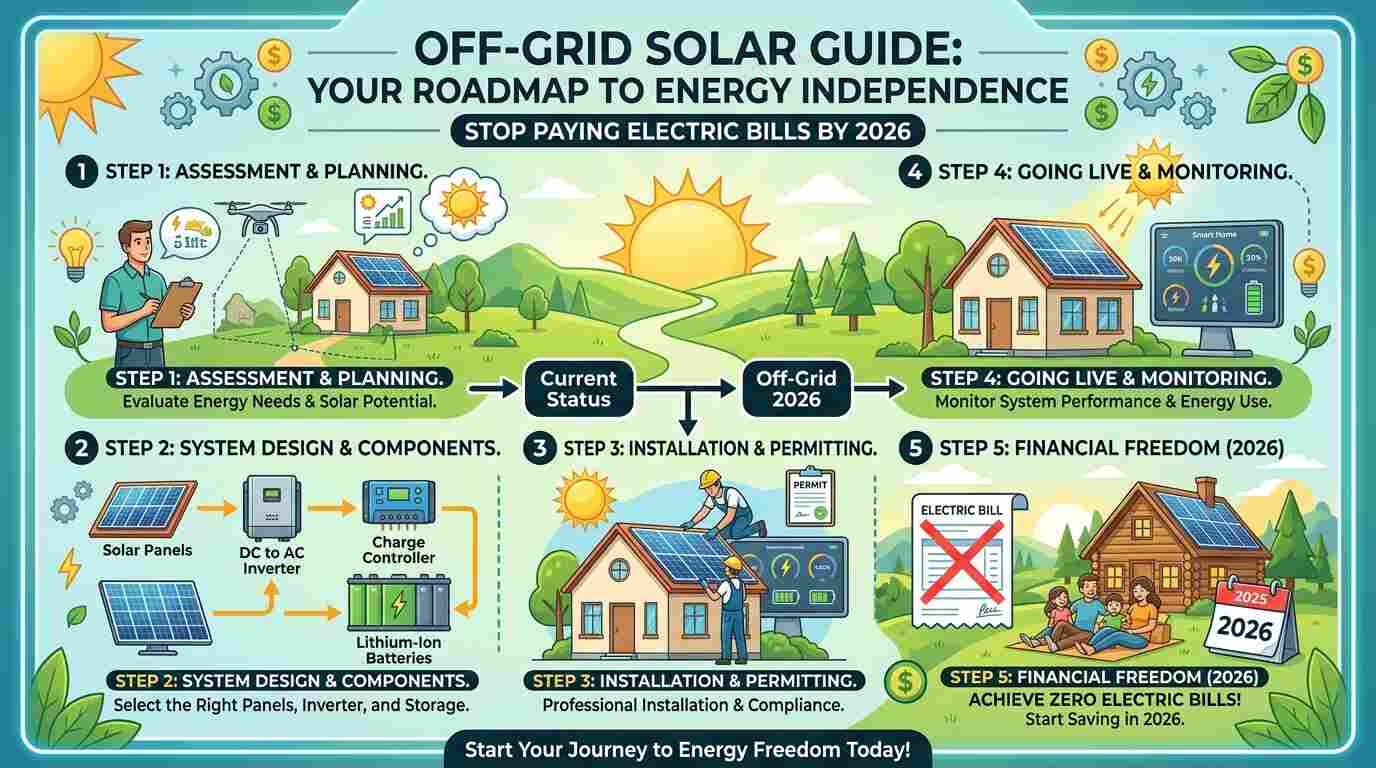
Three converging factors make now the actual right time to go off-grid — not five years ago when technology was primitive, and not in three years when better tech emerges.
First: Battery costs have collapsed. A 10 kWh lithium battery system cost $10,000–$14,000 in 2020. In 2026, the same system costs $3,500–$6,000. This single factor cuts years off your payback period and makes off-grid achievable for middle-income homeowners, not just the wealthy.
Second: Solar panel efficiency hit a practical ceiling. You’re no longer chasing marginal improvements. A $400 panel today produces what a $700 panel did in 2022. This means your upfront investment stabilizes while component costs continue falling elsewhere in the system.
Third: The grid itself is becoming less reliable in many US regions. Rolling blackouts, transmission congestion, and extreme weather disrupt power more frequently. Off-grid isn’t just financial optimization anymore — it’s increasingly about resilience and control.
Your electricity costs rise 6–8% annually. Your solar installation cost falls 3–5% annually. These lines will cross for most homeowners in 2026–2027. After that point, the financial case becomes obvious.
But the real question isn’t “Is it possible?” It’s “Is it right for me?” That requires brutal honesty first.
Can You Actually Go Off-Grid? Reality Check First
Before you price components or contact installers, answer these five questions with complete honesty.
Is your location sunny enough?
Off-grid solar requires your location to generate enough energy in winter to carry you through without the grid. If you live in the Pacific Northwest, northern New England, or Great Lakes region, off-grid is dramatically harder and more expensive than in Arizona, California, or the Southwest.
Here’s why: An Arizona home needs 4 kW of solar panels to be off-grid. The same Vermont home needs 7 kW — and still needs 4+ days of battery backup for cloudy stretches. That’s not 20% more expensive. That’s 40% more in panels, plus oversized batteries, for the same lifestyle.
Use this test: Check your location’s average monthly peak sun hours from the National Renewable Energy Lab solar resource map. If you’re under 3.5 hours per day in winter, off-grid becomes a luxury expense, not a practical choice.
Do you own your land outright?
Renters, HOA properties, and lease situations make off-grid nearly impossible legally and practically. You need:
- Permission to install rooftop or ground-mounted solar (not easy in HOAs)
- Freedom to store batteries on-site (often restricted or prohibited)
- No threat of forced removal in 5–10 years
- Zoning that allows off-grid systems
If you’re in an HOA without pre-approved solar, or you rent, stop here. Off-grid isn’t viable for you yet.
Can you handle 3–6 months of capital lockup?
Your off-grid system costs money upfront before you see any electrical return. A $45,000 system takes 18–25 years to break even against grid electricity. That means you need $45,000 in accessible capital without financing.
If your finances are stretched or you live paycheck-to-paycheck, off-grid will add stress, not freedom.
Are you willing to manage energy actively?
Off-grid isn’t set-it-and-forget-it like grid-tied solar. You must:
- Monitor battery state of charge (even with automation)
- Adjust usage during cloudy seasons
- Maintain the system annually
- Replace batteries in 12–15 years ($8,000–$15,000)
- Understand when to run the backup generator
If you want zero thought about electricity, grid-tied solar with net metering is dramatically smarter.
Are you staying long-term?
Off-grid solar adds value, but selling a home with off-grid is slower and discounted by 5–10%. Buyers want grid backup, not full independence.
If you might relocate in 8 years, off-grid’s ROI disappears completely.
Your honest answer: If you said YES to all five, move forward. If you hesitated on even one, consider hybrid off-grid (grid connection + solar + batteries) instead. It costs only 20% more but eliminates most of the operational complexity.
How Off-Grid Solar Actually Works (Not the Marketing Version)
Off-grid solar has four essential components. Each does one specific job. Together, they form a closed-loop power system that serves your home without the utility grid.
Solar panels (the power plant)
Solar panels convert sunlight directly into DC (direct current) electricity. Think of them as your private power plant. A typical residential off-grid system uses 8–15 panels at 400–550 watts each, for a total array between 3 kW and 8 kW.
The actual output varies wildly by season and weather:
- Summer peak: 100% of rated capacity
- Winter in sunny climates: 40–60% of rated capacity
- Cloudy days: 10–30% of rated capacity
- Rainy weeks: Near zero
This is why off-grid sizing differs from grid-tied sizing. You’re not sizing for average production. You’re sizing for worst-case winter, then accepting that you’ll have excess power in summer that gets stored in batteries.
Charge controller (the traffic cop)
The charge controller is the system’s intelligence. It takes power from solar panels and routes it safely to batteries, preventing overcharging and damage.
Two types exist:
- PWM controllers (cheaper, less efficient, good for small systems)
- MPPT controllers (more expensive, 20–30% more efficient, better for serious systems)
For off-grid, always choose MPPT. The efficiency gain pays for itself within 2–3 years through better energy capture.
Battery bank (the storage)
Batteries store daytime solar energy so you have power after sunset and during extended cloudy periods. Batteries are the most critical and most expensive component—and the reason off-grid costs 2–3x more than grid-tied solar.
Modern systems use lithium iron phosphate (LiFePO4) batteries. They cost $3,500–$6,000 per 10 kWh of storage but last 12–15 years and require almost no maintenance.
Older lead-acid batteries are cheaper upfront ($1,500 per 10 kWh) but degrade faster, require monthly watering, and last only 5–8 years. Do not use lead-acid unless your total budget is under $10,000. The payback math doesn’t work.
Inverter (the translator)
Your panels and batteries produce DC electricity. Your home uses AC (alternating current) electricity. The inverter converts one to the other.
A typical household needs a 5,000–10,000 watt inverter. Always choose pure sine wave inverters—they produce clean power safe for all appliances. Modified sine wave inverters are cheaper but damage sensitive electronics over time.
How they connect (the system flow):
☀️ Sunlight
    ↓
[Solar Panels] — Generate DC power
    ↓
[Charge Controller] — Directs power
    ↓
[Battery Bank] — Stores power
    ↓
[Inverter] — Converts DC to AC
    ↓
🏠 Your Home Uses AC Power
During the day, excess solar power charges batteries. At night, batteries discharge through the inverter to power your home. During cloudy weeks, you draw down battery charge gradually until sunny weather returns.
The core reality: Sizing batteries large enough to carry you through your worst seasonal stretch (usually winter) is the defining decision. Size too small and you’ll hit zero power in a cloudy week. Size too large and you waste money on unused capacity.
Off-Grid Solar Costs 2026: Real Numbers by System Size
Pricing is where solar marketing becomes dishonest. Articles claim off-grid solar costs the same as grid-tied solar. It doesn’t. Batteries are why.
Here’s the real 2026 cost breakdown:
Small System (5 kW solar, 15 kWh batteries)
Best for: Remote cabin, guest house, small off-grid property
Monthly power: Covers essentials (lights, fridge, water pump, basic loads)
Realistic monthly consumption: 3–5 kWh/day
| Component | Cost Range |
|---|---|
| Solar panels (5 kW at $0.50/W) | $1,500–$2,500 |
| MPPT charge controller (50A/48V) | $400–$800 |
| Battery bank (15 kWh LiFePO4) | $4,500–$8,000 |
| Pure sine inverter (5 kW) | $1,200–$2,500 |
| Wiring, breakers, disconnect switches | $800–$1,500 |
| Mounting system (roof or ground) | $400–$800 |
| Installation labor (professional) | $2,000–$5,000 |
| TOTAL (DIY Assembly) | $8,000–$15,000 |
| TOTAL (Professional Installation) | $12,000–$22,000 |
Medium System (8 kW solar, 25 kWh batteries)
Best for: Average 3–4 person household
Monthly power: Full household use including washer, water pump, limited AC
Realistic monthly consumption: 6–10 kWh/day
| Component | Cost Range |
|---|---|
| Solar panels (8 kW) | $2,400–$4,000 |
| MPPT charge controller (80A/48V) | $600–$1,200 |
| Battery bank (25 kWh LiFePO4) | $8,000–$14,000 |
| Pure sine inverter (8 kW) | $2,000–$4,000 |
| Wiring, breakers, disconnect switches | $1,200–$2,000 |
| Mounting system | $600–$1,200 |
| Installation labor | $4,000–$8,000 |
| TOTAL (DIY Assembly) | $18,000–$33,000 |
| TOTAL (Professional Installation) | $28,000–$50,000 |
Large System (12 kW solar, 40 kWh batteries)
Best for: All-electric home, 5+ people, electric vehicle charging
Monthly power: Everything—zero power restrictions
Realistic monthly consumption: 15–25 kWh/day
| Component | Cost Range |
|---|---|
| Solar panels (12 kW) | $3,600–$6,000 |
| MPPT charge controller (100A/48V) | $800–$1,500 |
| Battery bank (40 kWh LiFePO4) | $13,000–$22,000 |
| Pure sine inverter (10 kW) | $3,000–$6,000 |
| Wiring, breakers, disconnect switches | $1,800–$3,000 |
| Mounting system | $800–$1,500 |
| Installation labor | $6,000–$12,000 |
| TOTAL (DIY Assembly) | $28,000–$50,500 |
| TOTAL (Professional Installation) | $42,000–$70,000 |
What’s Hidden in These Prices (Plan Extra Budget):
- Permits and inspections: $500–$2,000 (varies dramatically by jurisdiction)
- Concrete pads or ground mounts: $1,000–$3,000
- Backup generator: $2,000–$5,000 (for winter peace of mind)
- Trenching for underground wiring: $1,000–$3,000
- Monitoring system upgrade: $300–$800
- Battery replacement in year 12–15: $8,000–$15,000
The honest total cost of living off-grid for 20 years is approximately 1.5x the initial installation price.
Regional Cost Differences (Geography Matters Hugely):
Same system size, dramatically different prices:
| Region | Solar Cost Mod | Battery Cost Mod | Reason |
|---|---|---|---|
| Arizona (baseline) | -15% | -10% | Installer competition, abundant sun |
| California (baseline) | Base (0%) | Base (0%) | Market pricing baseline |
| Texas | -5% | Base | Growing market, mid-range sun |
| Florida | +10% | +5% | Hurricane premiums, fewer installers |
| Pacific Northwest | +25% | +20% | Poor winter sun = larger system required |
| Northeast | +20% | +25% | Severe winters = massive battery banks needed |
| Rural/Remote | +30% | +40% | Travel time, fewer qualified installers |
Real example: An 8 kW system costs $28,000 in California, $38,000 in Oregon, and $40,000 in rural Maine—for identical equipment.
When Off-Grid Becomes Financially Sensible:
Off-grid solar breaks even when at least three of these apply:
- Grid connection cost exceeds $15,000 (common in rural areas needing pole extension)
- Your electricity costs exceed $0.18/kWh (Hawaii, California peak rates, expensive rural co-ops)
- You have 15+ years before relocating (time to amortize the investment)
- Your location gets 4+ average peak sun hours/day in winter (sunny climates)
- Your annual grid power cost exceeds $2,400 (about $200/month baseline)
If only one or two of these apply, grid-tied solar with net metering is cheaper.
Step-by-Step: How to Design Your Off-Grid System
Don’t order a single component until you’ve sized properly. A $40,000 mistake happens when sizing is guessed instead of calculated.
Calculate Your Daily Energy Consumption
List every electrical appliance you’ll use. Write down wattage and average daily usage in hours.
| Appliance | Watts | Hours/Day | Daily Wh |
|---|---|---|---|
| LED lighting (whole house) | 150 | 6 | 900 |
| Refrigerator | 150 | 8 (intermittent) | 1,200 |
| Well pump | 750 | 2 | 1,500 |
| Washer/dryer | 2,000 | 1.5 (combined) | 3,000 |
| Microwave | 1,200 | 0.5 | 600 |
| TV, computer, WiFi | 200 | 8 | 1,600 |
| Water heater (limited) | 3,500 | 0.5 (minimal) | 1,750 |
| TOTAL DAILY CONSUMPTION | 10,550 Wh |
Your baseline: ~10.5 kWh/day
Reality adjustment: Off-grid owners typically reduce consumption 30–40% through efficient appliances, behavioral changes, and understanding true costs. A realistic target is 6–8 kWh/day for a comfortable household.
Adjusted consumption: 7 kWh/day
Size for Winter Production
Your system must generate enough power in your worst month (usually December/January) to survive without grid backup.
Look up your location’s winter peak sun hours from NREL. Most US locations receive:
- Southwest: 4–5 hours/day
- Mid-South: 3–4 hours/day
- Upper North: 2–3 hours/day
- Pacific Northwest: 1.5–2.5 hours/day
Formula: Daily consumption ÷ winter peak sun hours = solar array watts
7,000 Wh ÷ 3 peak sun hours = 2,333 watts
Round up 20% for safety margin: Order 2,800–3,000 watts of solar panels.
This is non-negotiable. Undersizing in cold climates creates winter power failures.
Calculate Battery Bank Size
Your battery bank must carry you through worst-case without sun—usually 3–4 days in winter.
Formula:
(Daily consumption × Autonomy days) ÷ Depth of discharge = Battery capacity
(7,000 Wh × 4 days) ÷ 0.80 = 35,000 Wh = 35 kWh
Translation: You need 35 kWh of storage. At $250–$400 per kWh, that’s $8,750–$14,000 just for batteries.
This is where most people either commit or pivot to hybrid/grid-tied. Batteries are the financial reality checkpoint.
Choose Your Charge Controller
Your controller must handle peak solar current.
Formula: Solar watts ÷ Battery voltage = Max amps
3,000W ÷ 48V = 62.5 amps
Choose a controller rated for 80+ amps at 48V. Budget $800–$1,200.
Size Your Inverter
Your inverter must handle your peak simultaneous load plus surge capacity.
Washer (800W) + Water heater (4,500W) + Microwave (1,200W) = 6,500W continuous
Add 50% surge (for motor startup): 6,500 × 1.5 = 9,750W
Order a 10,000-watt inverter minimum. Budget $2,000–$4,000.
Assemble Your Component List
Now you have real numbers:
- Solar: 3 kW (8 × 400W panels)
- Batteries: 35 kWh LiFePO4
- Charge controller: 80A MPPT at 48V
- Inverter: 10 kW pure sine wave
- Wiring, breakers, mounts: $1,500
Total materials: $15,000–$25,000
With professional installation: $28,000–$42,000
This is the moment to pause and ask: “Does this number make sense for my situation?” If it makes you deeply uncomfortable, that’s a design signal. You’re either not ready yet, or you should explore hybrid systems.
What Solar Companies Won’t Tell You About Off-Grid
After month six of operation, the reality becomes crystal clear. This is what solar installers gloss over in sales presentations.
Batteries degrade constantly
Every charge-discharge cycle reduces battery capacity slightly. A LiFePO4 battery loses about 2–3% of capacity per year in normal use.
- Year 1: 100% capacity (rated)
- Year 5: ~90% capacity
- Year 10: ~80% capacity
- Year 15: ~70% capacity
This doesn’t mean they fail. It means your “35 kWh battery” really stores 28 kWh in year 10. You’ll notice shorter runtime on cloudy days. You might need to adjust expectations about winter behavior.
What this means: Don’t buy a battery bank assuming full performance forever. Assume 12–15 years of full performance, then 3–5 years of degraded performance before replacement.
Winter requires active energy management
Winter has fewer peak sun hours, shorter days, and clouds. Your battery charges slower and you use power faster (longer nighttime, heating loads). The gap between summer and winter is shocking.
Summer: You might have excess solar power.
Winter: You’re running on low charge constantly, adjusting usage.
Most off-grid owners adopt seasonal behavior shifts:
- Summer: Run high-power appliances (washer, AC, water heater) freely
- Winter: Batch laundry, avoid simultaneous loads, minimize water heating
- Late fall/early spring: Stay vigilant about consumption
If you want zero behavioral restrictions in winter, you’d need such a massive battery bank that you’re massively overspending for summer. Most people compromise instead.
What this means: Off-grid isn’t passive. It requires active energy awareness, especially October through March.
You will use a backup generator
The financial case for off-grid assumes you’ll use a backup generator (propane or diesel) during extended cloudy periods. These are rare but possible in winter—maybe 3–5 events yearly, lasting 2–8 hours each.
A small 6–10 kW generator costs $1,500–$3,000 and burns $10–$20 of fuel per usage event.
Including a generator adds ~10% to system cost but prevents the uncomfortable scenario where you’re out of battery power at 3 a.m. with 10 cloudy days forecast.
What this means: True independence requires a mechanical backup. Without it, you’re always slightly anxious.
Permits and zoning can derail the entire project
Off-grid solar is still new in many jurisdictions. Your county might:
- Require grid connection if public lines exist nearby (some states legally require it)
- Limit battery storage in neighborhoods
- Require specific inspection pathways you can’t use (some areas mandate local contractors, no DIY)
- Have unclear rules that mean “we’ll figure this out as we go”
These problems cost $1,000–$5,000 to resolve and can add 3–6 months to your timeline.
What this means: Start researching permitting before you order anything. Call your county planning office.
Maintenance is more involved than marketing admits
Your system doesn’t maintain itself. Actual annual work includes:
- Battery monitoring (monthly, 10 minutes)
- Inverter status checks (monthly, 5 minutes)
- Solar panel cleaning (quarterly, 1 hour)
- Electrical connection inspection (annual, 30 minutes)
- Charge controller log review (annual, 20 minutes)
- Battery capacity testing (every 2 years, 2 hours)
- System efficiency audit (annual, 1 hour)
Total annual maintenance: ~8 hours of your time, or $400–$800 if you hire a technician.
If you’re someone who ignores home maintenance, off-grid will frustrate you. You need basic system literacy.
Real Example: One Family’s First Year Off-Grid
This is what the marketing brochures hide.
The Family: Jennifer and Mark, 3 children, rural Pennsylvania (USDA Zone 5)
Decision point: Tired of $210/month electric bills and rural grid unreliability
System installed: October 2024
System specifications:
- 8 kW solar panels (20 × 400W)
- 30 kWh lithium battery bank (LiFePO4)
- 10 kW pure sine inverter
- 8 kW propane backup generator
- Total installed cost: $41,200 (originally quoted $38,000)
What Actually Happened:
October–November (Installation Phase):
- System took 8 weeks to permit and install (quoted 4 weeks)
- Actual cost: $41,200 (permits alone: $1,800)
- First week: Kept tripping breakers because they ran too many appliances simultaneously
- Second week: Discovered the solar monitoring app they assumed was automatic requires daily monitoring
- Emotional reality: “Excited but slightly terrified”
December (First Full Winter Month):
- System generated only 40% of what the designer promised
- Weather forecast said 3 cloudy days; became 8 consecutive cloudy days
- Battery hit 20% charge state on day 6
- Used backup generator for 4 hours (cost: $12 propane)
- Had to abandon the dryer, limit showers, reschedule laundry
- Emotional reality: “Did we make a terrible mistake?”
January (The Adjustment Month):
- Completely rewired their thinking
- Washer now runs on sunny mornings only
- Water heating limited to 30 minutes daily
- Dryer permanently shelved (clothes hung instead)
- System performed exactly as designed (barely covering needs)
- Generator used only once
- Emotional reality: “Okay, this is doable. It’s just different.”
February–March (System Understanding):
- Multiple consecutive sunny days = surplus power they couldn’t store
- Realized they undersized battery (should have been 40 kWh)
- Still manageable, but confirms winter is structurally tight
- Generator used zero times
- Emotional reality: “I understand the system now”
April–September (Summer Paradise):
- System generated 2× what they needed
- Appliances ran freely—it was glorious
- Electric bills: $0 (they sold excess back through a hybrid inverter upgrade)
- Generator off entire summer
- Emotional reality: “Why didn’t we do this sooner?”
Year-One Financial Reality:
- Electric bill savings: $1,800 (what they avoided)
- Unexpected costs: $2,400 (permit overages, monitoring system, propane for generator)
- Time investment: 6 hours/month average
- Payback timeline: 23 years (assuming 5% electricity rate increase annually)
Their honest assessment after 12 months:
“The financial case is weaker than the brochure. But the independence is real. No more grid failure anxiety. No more $200 electric bills eating our budget. We own our power now. That matters more to us than the money.”
What surprised them most:
- Winter requires active management — they had expected passive operation. You can’t be lazy.
- Battery oversizing would have been smarter — adding 10 kWh would eliminate generator use and winter stress
- Their lifestyle adapted faster than expected — they don’t miss the dryer after month 2
- The learning curve flattened dramatically after month 3 — it became normal
Professional Consultation & Legal Considerations
Before installation, address these legal and professional realities.
When to hire professionals:
You should hire a licensed solar electrician for:
- Electrical work (most jurisdictions require it)
- High-voltage battery bank installation
- Inverter configuration (safety-critical)
- Permitting and inspection coordination
You can DIY:
- Installing mounting hardware
- Running low-voltage wiring (under 50V)
- Panel connections (if following code strictly)
- System design and planning
Local permits and zoning:
Call your county planning office before ordering anything. Ask:
- “Can I install an off-grid solar system on my property?”
- “What permits are required?” (Answer: probably electrical + building)
- “Do I need grid connection even if I’m off-grid?” (Answer: maybe)
- “Are there restrictions on battery storage?” (Answer: varies wildly)
- “Who can do the installation work?” (Answer: sometimes licensed contractor only)
Insurance implications:
Most homeowner’s insurance does NOT automatically cover off-grid systems. You must:
- Notify your insurer before installation
- Often add a “renewable energy equipment rider” ($20–$50/year extra)
- Some insurers refuse off-grid coverage completely
Get written confirmation from your insurer before installation. If they won’t cover it, call specialist insurers (some solar-specific policies exist).
HOA and neighborhood restrictions:
If you’re in an HOA, get written approval before installing. Even “owner approval” isn’t enough—you need HOA board documentation. Many HOAs restrict:
- Ground-mounted solar (aesthetics)
- Battery storage (safety concerns)
- Pole-mounted systems
Grid connection (still usually required):
Most jurisdictions require you to maintain grid connection if public lines exist nearby—even if you never use it. This means:
- A small meter fee ($15–$25/month)
- A Grid Tie Interconnection Agreement with your utility
- You still have grid access if needed (emergencies, failures)
This isn’t a disadvantage—it’s insurance against catastrophic off-grid failure.
Common Off-Grid Mistakes (And What They Cost)
These are real failures from actual installations, not hypothetical errors.
Undersizing the battery bank (Most common)
What happens: You save money upfront ($5,000–$8,000), then discover winter is impossible without constant generator use.
Cost of mistake: $8,000–$15,000 (battery expansion 2–3 years later, when you can’t afford it)
How to avoid: Follow the 4-day autonomy rule religiously. Don’t compromise on battery size—it’s the non-negotiable system foundation. If the number scares you, go hybrid instead.
Wrong voltage system (24V instead of 48V)
What happens: You choose 24V to save $2,000 initially, then discover:
- Voltage drop in long wiring runs
- Limited equipment availability
- Inefficiency and power losses
- Forced component replacement
Cost of mistake: $3,000–$8,000 (rewiring and component replacement)
How to avoid: Use 48V for all household systems. It’s more efficient, has vastly more equipment options, and future-proofs your system.
Choosing lead-acid instead of lithium
What happens: Initial savings of $3,000 evaporate when batteries need replacement in 5 years instead of 15.
Cost of mistake: $8,000–$12,000 (total cost over time, not upfront)
How to avoid: Lithium costs more upfront but saves money over 20 years. The full lifecycle cost math is crystal clear.
Skipping the backup generator
What happens: One severe winter, and you’re forced to buy a generator under duress at retail prices, or run out of power.
Cost of mistake: $2,000–$5,000 (rushed purchase at poor pricing)
How to avoid: Budget for a generator from the beginning. Even renting one for winter ($300–$500) is better than being unprepared.
Not planning for battery replacement
What happens: Year 13 arrives, batteries degrade below usability, you have zero budget set aside.
Cost of mistake: $12,000–$18,000 (forced emergency replacement)
How to avoid: Save $800–$1,200/year starting now. That’s $10,000–$15,000 when you need it. Won’t cover everything, but softens the blow.
Installing in a location you’ll abandon
What happens: You move in 6 years, leave $20,000–$30,000 of equipment behind, take a massive loss.
Cost of mistake: $15,000–$25,000 (lost investment value + selling discount on property)
How to avoid: Only go off-grid if you plan 15+ years in this location. If relocation is possible, grid-tied is infinitely smarter.
The Bottom Line
Off-grid solar is achievable in 2026 not because the technology suddenly became perfect, but because battery costs finally fell enough to make the financial case reasonable for middle-income households.
But achievable doesn’t mean right for everyone. Off-grid requires upfront capital you won’t recover for 18–25 years. It demands winter energy management. It trades passive grid reliability for active independence.
Hybrid off-grid (grid backup + solar + batteries) is smarter for 70% of people evaluating this decision. It costs 20% more than pure off-grid but eliminates 80% of the complexity.
Your honest next step: Take the readiness assessment above. Based on your score, schedule a consultation with a local licensed solar electrician. Get a real quote for your actual situation. Make a decision based on numbers, not marketing.
That’s how you stop paying electric bills—not through magic, but through honest planning.
FAQs About Off-Grid Solar
Q: How much does it actually cost to go off-grid with solar?
A: 2026 costs range from $8,000 (small DIY cabin system) to $70,000 (large professional household). Most average households spend $28,000–$50,000 installed. Add $8,000–$15,000 for battery replacement in year 12–15. Cost varies 50% between regions (Arizona vs. Vermont for same system).
Q: Can you really go 100% off-grid with just solar and batteries?
A: Yes, but with asterisks. You need: (1) at least 4+ winter peak sun hours daily, (2) battery bank sized for 4–6 autonomy days, (3) willingness to adjust behavior during cloudy stretches, and (4) a backup generator for extended cloud cover. If all four apply, yes.
Q: How many solar panels do I need to go off-grid?
A: It depends on three variables: (1) your daily consumption, (2) your location’s winter peak sun hours, and (3) your acceptable autonomy days. Formula: consumption ÷ winter PSH = array size needed. A 7 kWh/day household in Arizona needs 2 kW. The same household in Vermont needs 3.5 kW. Location matters more than total watts.
Q: What happens to your off-grid system at night or during cloudy weeks?
A: During the day, excess solar charges batteries. At night, batteries discharge to power your home. During cloudy weeks, battery charge depletes gradually. If you hit 10–15% battery charge, you run the backup generator to charge batteries while powering the home simultaneously. This is designed behavior, not failure.
Q: Can you add more solar panels or batteries later if you need to expand?
A: Yes, but it costs 15–20% more to retrofit than sizing correctly upfront. Adding batteries requires matching the voltage/chemistry of existing batteries (often requires replacing everything). Better to size conservatively upfront, live with it for a year, then expand when you know exactly what you need.
Q: Will my homeowner’s insurance cover an off-grid solar system?
A: Not automatically. You must notify your insurer and often add a “renewable energy equipment rider” ($20–$50/year extra). Some insurers refuse off-grid coverage entirely. Get written approval before installation. If your insurer won’t cover it, specialized solar insurance exists (search “solar insurance”).
Q: Will I be able to sell my house if it’s off-grid?
A: Yes, but slower and at a discount. Off-grid homes sell 10–20% slower because most buyers want grid backup. You’ll likely price $5,000–$15,000 lower than equivalent grid-tied homes. If you plan to move in 8 years, this cost impacts your ROI significantly.
Q: Do I still need to stay connected to the electric company grid?
A: Most jurisdictions require grid connection if lines exist nearby—even if you never use it. You’ll pay a small meter fee ($15–$25/month) even with zero usage. This is actually beneficial (insurance), not a disadvantage.