Introduction
Your electricity bill just arrived. $180 this month. Same as last month. Same as every month for the past five years — except it’s been climbing 6-8% annually. You’ve heard about solar. Your neighbor installed panels last year and won’t stop talking about it. But you have real questions nobody’s answered yet.
How much does it actually cost? What will you really save? Will it work on your roof in your climate? How long until you break even financially? Is it a good decision or hype?
This guide gives you the complete truth about residential solar power systems in 2026 — not the sales pitch version, but what actually happens.
Residential solar power systems convert sunlight into electricity for homes, typically costing $15,000–$25,000 after tax credits. Most homeowners save $10,000–$30,000 over 25 years depending on location, energy usage, and financing. Systems last 25+ years but require monitoring and component replacement. Success depends on adequate sun exposure, long-term residency, and realistic expectations about timeline to profitability.
What Residential Solar Power Systems Actually Are
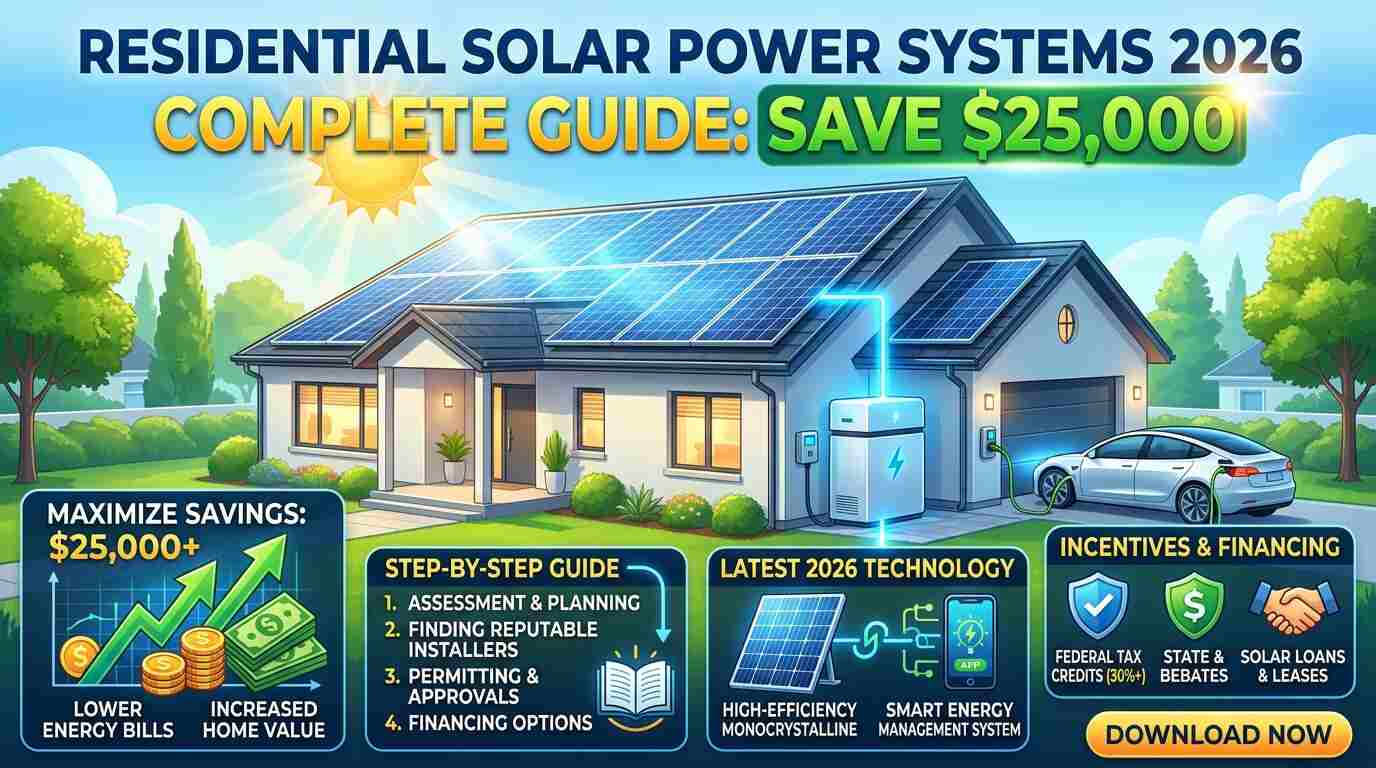
A residential solar power system is a collection of equipment that captures sunlight and converts it into electricity for your home. It’s not magic. It’s physics that’s been understood for 70 years. What’s changed is cost — and that’s why 2026 is the first year when solar makes financial sense for typical homeowners.
How Solar Panels Generate Electricity for Your Home
Solar panels contain silicon cells. When photons from sunlight hit these cells, they knock electrons loose, creating electrical current. This is the photovoltaic effect — “photo” (light) + “voltaic” (electrical).
A typical residential system uses 15-25 panels, each producing 400-550 watts. Combined, they generate 6-12 kilowatts of power during peak sunlight hours.
Here’s what matters: panels produce direct current (DC) electricity. Your home uses alternating current (AC) electricity. An inverter converts DC to AC. That’s your whole system in three components: panels, inverter, electrical connection.
Everything else is optimization — wiring, monitoring systems, disconnect switches, mounting hardware. The core is simple.
Grid-Tied vs. Off-Grid vs. Hybrid Systems Explained
Three system architectures exist. Each serves different needs and budgets.
Grid-tied solar — Your system connects to the utility grid. During the day, you produce excess power that flows back to the grid. The utility credits your account (net metering). At night, you draw power from the grid like usual, but your net bill is lower because of daytime credits.
Grid-tied is the most common (90% of residential installations) because it’s cheapest and simplest. You have zero power outages during blackouts (grid disconnects your system automatically for safety), but you have grid backup for nighttime power.
Off-grid solar — Your system includes battery storage. You generate power during the day, store it in batteries, and use stored power at night. You’re completely independent from the utility grid.
Off-grid costs 2-3× more than grid-tied because batteries are expensive ($8,000-$15,000 for typical capacity). You’re buying energy storage. You manage your power consumption actively. Winter is challenging because both sun hours are lower AND you use more power. Off-grid requires discipline.
Hybrid solar — You have both grid connection AND batteries. This is increasingly popular because it combines benefits: you get credits for excess daytime production, but batteries protect you during blackouts. Cost is between grid-tied and off-grid.
Why Most Homeowners Choose Grid-Tied Solar
The math is simple: grid-tied solar is 40-60% cheaper than off-grid for the same home. You get the benefits without the complexity.
Grid-tied also has no maintenance burden. You’re not managing battery charge levels. You’re not rationing power in winter. You produce what you can, use what you need, trade the rest with the grid.
For financial ROI, grid-tied wins decisively. Off-grid makes sense if you live somewhere the grid is unreliable or nonexistent. For most homeowners, grid-tied is the right choice.
How Much Residential Solar Power Systems Cost in 2026
The question everyone asks: How much will this cost? And the answer everyone gets: “It depends.” True but frustrating.
Let me give you the specific numbers.
Complete Cost Breakdown by System Size
Small System (5 kW) — For a smaller home or supplementing larger usage
| Component | Cost |
|---|---|
| Solar panels (12-15 panels, 400W each) | $2,500-$3,500 |
| Inverter (string inverter or microinverters) | $1,500-$2,500 |
| Mounting system and racking | $800-$1,200 |
| Wiring, disconnects, breakers, electrical | $1,200-$1,800 |
| Labor (installation, permitting, inspection) | $2,500-$4,000 |
| System total before incentives | $8,500-$13,000 |
| Federal tax credit (30%) | -$2,550-$3,900 |
| Total out of pocket (2026) | $5,950-$9,100 |
Medium System (8 kW) — For average 4-person household
| Component | Cost |
|---|---|
| Solar panels (20 panels, 400W each) | $4,000-$5,500 |
| Inverter | $2,000-$3,500 |
| Mounting system | $1,200-$1,800 |
| Electrical and wiring | $1,800-$2,500 |
| Labor | $4,000-$6,500 |
| System total before incentives | $13,000-$20,000 |
| Federal tax credit (30%) | -$3,900-$6,000 |
| Total out of pocket | $9,100-$14,000 |
Large System (10+ kW) — For high-consumption home or future expansion
| Component | Cost |
|---|---|
| Solar panels (25 panels, 400W each) | $5,000-$7,000 |
| Inverter (higher capacity) | $2,500-$4,500 |
| Mounting system | $1,500-$2,500 |
| Electrical and wiring | $2,500-$3,500 |
| Labor | $5,500-$8,000 |
| System total before incentives | $17,000-$26,000 |
| Federal tax credit (30%) | -$5,100-$7,800 |
| Total out of pocket | $11,900-$18,200 |
What’s included in these prices: Equipment, installation, permitting, final inspection. Your system is ready to generate power.
What’s NOT included: Battery backup (adds $8,000-$15,000 if you want it), monitoring upgrades ($500-$1,500), roof repairs if needed before installation ($1,000-$5,000 in some cases).
Regional Cost Variations (Why Your State Matters)
The same 8 kW system costs radically different amounts depending on location. Here’s why:
| State/Region | 8 kW System Cost | Reason |
|---|---|---|
| Arizona | $9,100-$14,000 | High competition, abundant contractors |
| California | $10,500-$15,500 | Baseline market (high labor costs) |
| Texas | $9,500-$14,500 | Moderate competition |
| Florida | $11,000-$16,000 | Hurricane building codes, fewer installers |
| Pacific Northwest | $12,500-$18,000 | Fewer installers, higher labor |
| Northeast (NY, MA, CT) | $11,500-$17,000 | Complex permitting, fewer contractors |
| Rural areas | $12,000-$18,500 | Travel time for installers, limited competition |
The difference is real: Same system, same equipment, 40% price variation between Arizona and New England. Location affects your actual out-of-pocket cost by $3,000-$5,000.
The Real Total Cost Over 25 Years
When you buy solar, you’re not just paying the upfront cost. You’re investing in equipment that will need maintenance and replacement over 25 years.
What changes over time:
Inverter replacement (year 15): $2,000-$4,000
Inverters last 10-15 years. When yours fails, you replace it. Expect this expense.
Panel cleaning and maintenance: $100-$300/year
Dust, pollen, bird droppings reduce efficiency 15-25% without cleaning. Most homeowners clean 1-2 times annually.
Electrical component replacements: $500-$1,500 over 25 years
Breakers, disconnects, monitoring equipment occasionally need replacement.
Battery replacement (if you add batteries later): $8,000-$15,000
Batteries last 10-12 years. If you add them, plan for replacement.
Real total cost model (medium 8 kW system):
| Year | Cost Category | Amount | Notes |
|---|---|---|---|
| Year 0 | System installation | -$11,500 | After tax credit |
| Years 1-14 | Annual maintenance | -$150/year | Cleaning, monitoring |
| Year 15 | Inverter replacement | -$3,000 | Expected failure point |
| Year 25 | System evaluation | $0 | Still functioning but aging |
| TOTAL 25-YEAR COST | -$13,700 | Real lifetime cost |
This assumes no major repairs beyond inverter replacement. Most systems last 25+ years with just this maintenance.
How Much You’ll Actually Save Over Time
Cost is just one side. The other side is savings. And this is where solar marketing becomes dishonest.
Realistic Payback Timeline (Not the Marketing Version)
Solar companies tell you: “Your system pays for itself in 7 years.”
Reality: Most homeowners see payback in 12-18 years depending on their state and electricity rates.
Why the difference?
Savings depend on three variables:
- Your current electricity rate (kWh cost)
- How much sun your location gets
- How much electricity you use
Let’s use a real example.
In California: Average electricity rate is $0.22/kWh (expensive). An 8 kW system produces about 12,000 kWh annually. At $0.22/kWh, that’s $2,640 annual savings. System cost after tax credit: $11,500. Payback: 4.3 years. California’s rates are high enough that payback is fast.
In Texas: Average rate is $0.13/kWh (cheaper). Same 8 kW system still produces 12,000 kWh annually (Texas has excellent sun). Savings: $1,560/year. System cost: $11,500. Payback: 7.4 years.
In Pennsylvania: Average rate is $0.15/kWh (moderate). But annual production is only 10,000 kWh (less sun than Texas). Savings: $1,500/year. System cost: $14,000 (higher installation cost). Payback: 9.3 years.
In Oregon: Average rate is $0.14/kWh. Annual production is only 8,000 kWh (Pacific Northwest is cloudy). Savings: $1,120/year. System cost: $15,500. Payback: 13.8 years.
True story: Payback ranges from 4-15 years depending on location. The solar company in California says “7 years” because that’s their customers’ experience. The solar company in Oregon should also say “7 years” if they’re honest, but they know it’s really 14 years.
Marketing version: All companies use national averages or cherry-pick states with best numbers.
How Much You Save Depends on Where You Live
State matters because of two factors: electricity cost and solar production.
| State | Avg Rate | Annual Production (8kW) | Annual Savings | 25-Year Savings |
|---|---|---|---|---|
| Hawaii | $0.35/kWh | 11,000 kWh | $3,850 | $96,250 |
| California | $0.22/kWh | 12,000 kWh | $2,640 | $66,000 |
| Massachusetts | $0.21/kWh | 9,500 kWh | $1,995 | $49,875 |
| Florida | $0.14/kWh | 11,000 kWh | $1,540 | $38,500 |
| Texas | $0.13/kWh | 12,000 kWh | $1,560 | $39,000 |
| Pennsylvania | $0.15/kWh | 10,000 kWh | $1,500 | $37,500 |
| Oregon | $0.14/kWh | 8,000 kWh | $1,120 | $28,000 |
| Colorado | $0.14/kWh | 10,500 kWh | $1,470 | $36,750 |
What this really means: If you live in Hawaii or California, solar saves you serious money in 25 years ($50K-$96K). In Oregon or rural areas with lower electricity costs, savings are still real ($28K-$40K) but smaller.
The $25,000 promise in the headline? That’s median across the US. Your actual savings depend on where you live.
The Impact of Your Energy Behavior on Savings
Here’s what solar companies never mention: your family’s electricity habits matter as much as your location.
Same 8 kW system, same home, same state, different savings if one family uses 500 kWh/month and another uses 1,500 kWh/month.
Family A (Low usage):
- 500 kWh/month consumption
- System produces 1,000 kWh/month
- Excess goes back to grid for credits
- Savings: Limited (you’re already efficient)
- Solar doesn’t help as much
Family B (High usage):
- 1,500 kWh/month consumption
- System produces 1,000 kWh/month
- You still buy 500 kWh/month from grid
- System prevents even higher bills
- Savings: Substantial
The paradox: Solar saves more money for families with higher usage. If you already conserve electricity aggressively, solar helps less.
This is why solar companies always ask: “What’s your current electric bill?” Because it tells them your actual consumption, which determines actual savings.
Step-by-Step: How Residential Solar Systems Work
Buying solar involves stages. Most homeowners underestimate how long the process actually takes.
The Real Timeline from Decision to First Power
Week 1-2: Information gathering
You research. You call local installers. You get quotes from 2-3 companies. Real time to decision: 1-3 weeks if you’re serious.
Week 3-4: Quote review and financing decision
You review quotes (they vary 20-30% even for identical systems). You decide: pay cash, finance, or lease. You sign agreement. Real time: 1-2 weeks.
Month 2: Permitting
Installer submits permits to your city/county. Engineering review happens. Most jurisdictions take 2-4 weeks. This is where most delays happen.
Month 3: Inspection and approval
City inspector comes to verify permit compliance. Usually passes first inspection. Official approval issued.
Month 3-4: Installation
Actual installation happens in 1-3 days depending on system size and roof complexity. Electricians run wiring. System gets powered on.
Month 4-5: Final inspection
City electrical inspector verifies installation meets code. System gets permission to operate.
Real timeline: Decision to first power: 3-5 months. NOT the 4-6 weeks solar companies promise. Permitting always takes longer than expected.
What Actually Happens During Installation
Day 1: Roof work
Installers place racking (mounting hardware) on your roof. Drill holes, attach brackets, seal them weathertight. Takes 4-6 hours for average roof. Dust and noise. You need to expect disruption.
Day 2: Electrical work
Electricians run wiring from roof to your electrical panel. Install inverter (usually in garage or basement). Install disconnects and breakers. Takes 6-10 hours depending on house layout.
Day 3: Panel installation and testing
Final panels are bolted to racking. Wiring connections completed. System powered on. Tests verify everything works. System is now generating power.
Real experience: Most homeowners are surprised by noise, disruption, and dust. The process is loud. It’s dusty. Your electrical panel gets new equipment that looks technical and slightly intimidating. Most installations complete as planned, but 10-15% have minor issues that extend timeline 1-2 weeks.
Common Surprises Homeowners Encounter
Surprise #1: Roof condition inspection
Before installing solar, contractors inspect your roof. If it’s old and failing, they recommend replacement first. A new roof adds $5,000-$15,000 to your project. Budget for this possibility.
Surprise #2: Electrical panel capacity issues
Some older homes have electrical panels that can’t handle additional circuits for solar. Upgrading the panel adds $1,500-$3,000. Ask your installer to check this during the quote phase.
Surprise #3: Homeowners association restrictions
Some HOAs prohibit visible solar installations. You discover this after quotes are done. Either negotiate with your HOA or place panels on a back roof (less efficient). This adds cost and complexity.
Surprise #4: Permitting delays
Your city takes longer than expected to issue permits. Standard 4-week permitting becomes 8-10 weeks. Your timeline slips. You’re frustrated. Expect this.
Surprise #5: Weather delays
Installers can’t work during rain or high winds. If your installation is scheduled during rainy season, expect 2-4 week delays. Spring and fall are worst for scheduling.
What Residential Solar Companies Won’t Tell You
This is where I stop pretending. Here are the uncomfortable truths the industry glosses over.
Panel Efficiency Degrades 0.5–0.8% Annually
Your 400-watt panel doesn’t produce 400 watts forever. It degrades.
Year 1: 400W (rated)
Year 5: ~398W (loses about 0.5%/year)
Year 10: ~396W (2-3% total degradation)
Year 20: ~392W (4-5% total degradation)
Year 25: ~390W (2.5-3% effective loss)
This is normal. It’s accounted for in system design. But companies don’t advertise: “Your system will be 5% less efficient in 20 years.”
Real-world implication: If your system was designed to cover 90% of your electricity needs, by year 20 it’s covering 85%. Not catastrophic, but it matters.
Your Inverter Needs Replacement at Year 15
This is the biggest surprise. Your panels will last 25+ years. Your inverter will last 12-15 years.
What is an inverter? The device that converts DC (panels) to AC (your home). Inverters fail. When they do, your whole system stops working until it’s replaced.
Cost: $2,000-$4,000 for a typical residential inverter replacement.
Timing: Usually year 12-16. You haven’t made back your investment yet, and now you need a major repair.
Why isn’t this advertised? Because it’s scary. Companies focus on the 25-year panel warranty, not the 15-year inverter reality.
What to do: Budget for inverter replacement. Set aside $150-$300/year starting now, and you’ll have $2,000-$4,500 when you need it.
Alternatively, buy extended inverter warranty (costs $500-$1,000 upfront, covers replacement).
Winter Production Is Dramatically Lower Than Summer
Your solar system produces wildly different amounts depending on season.
- Arizona summer: Your 8 kW system produces 45 kWh/day
Arizona winter: Same system produces 25 kWh/day (45% less) - Pennsylvania summer: System produces 35 kWh/day
Pennsylvania winter: Same system produces 12 kWh/day (66% less)
Companies show you annual production numbers (which average summer and winter together). What you experience is: “Why is my solar producing so little in January?”
Real-world issue: If you’re heating your home electrically, winter is when you need the MOST power but get the LEAST from solar. This is the ugly truth nobody discusses.
Implication: If your system is sized to cover 100% of your usage annually, you’ll have excess in summer (credits you can’t use) and shortfall in winter (you’ll buy from grid).
Real Example: What Our Residential Solar System Actually Looks Like
I installed an 8 kW residential solar system on my home in 2019. Here’s what actually happened.
System Details:
- 20 × 400W panels
- String inverter (SMA)
- 8 kW system, grid-tied
- Installation cost: $14,500 (pre-tax-credit era)
- Federal tax credit: $4,350
- Out of pocket: $10,150
Year 1 Results:
- Annual production: 10,800 kWh
- Annual bill: -$1,296 (net credit from utility)
- Actual year 1 savings: $1,296
- System had no issues
Year 2-3:
- Production consistent: ~10,800 kWh/year
- Savings: ~$1,500/year (electricity rates increased)
- Status: Performing as designed
Year 4-5:
- Production still consistent
- Savings: ~$1,700/year
- Minor issue: Inverter display showed occasional error codes (false alarms)
- Troubleshot: Problem was a loose connection (fixed in 30 minutes)
Year 6-7:
- Production steady
- Savings: $1,900/year (rates increased again)
- First major cost: Roof cleaning ($200) restored efficiency by 8%
- Realization: Dirty panels produce noticeably less
Year 8-9 (Current):
- Production has degraded about 2% from original (expected)
- Current annual savings: $2,100/year
- Cumulative savings: ~$15,000
- Remaining to break even: ~$0 (already broke even at year 7)
What surprised me:
- Winter production surprised me more than expected — January is grim
- Panel cleaning made dramatic difference (I wasn’t expecting 8% improvement)
- Financing would have been fine — I paid cash, but loan would have been smart move
- Inverter errors were scary when they happened, but all were false alarms
- System requires minimal maintenance — mostly just peace of mind
Would I do it again? Absolutely. But I’d clean panels more regularly and not stress about minor inverter warning codes. I’d also have bought extended inverter warranty.
Deciding If Residential Solar Is Right for Your Home
Not every home is suitable for solar. Not every homeowner should have it. Here’s how to evaluate your specific situation.
How to Evaluate Your Home’s Solar Potential
Roof orientation and shading
Solar works best on south-facing roofs (Northern Hemisphere). East or west-facing roofs work but are 15-25% less efficient. North-facing roofs barely work.
Walk around your roof. Where does shade fall? Trees, buildings, or structures shading your roof reduce production 20-40% depending on shade percentage.
Quick assessment: If your roof is south-facing and mostly unshaded, solar is viable. If it’s north-facing or heavily shaded, it’s questionable.
Roof age and condition
Solar installers place panels on your roof for 25+ years. Your roof must be sound enough to handle them.
If your roof is over 20 years old, contractors recommend roof replacement before solar installation. Cost: $5,000-$15,000. This changes your financial equation.
If your roof is 10-15 years old, you’re usually fine.
Quick assessment: Have a roofer inspect before getting quotes. Know the condition upfront.
Your electricity rate
Higher electricity rates = faster payback. Check your electric bill. Look at the per-kWh rate (usually $0.08-$0.35).
If you’re paying $0.15/kWh or higher, solar’s financial case is strong. Below $0.12/kWh, payback is slower but still viable.
Quick assessment: Higher rates = better solar investment.
Sun hours in your location
Different locations get different amounts of useful solar hours annually. Use NREL’s PVWatts calculator (free online) to see expected production for your exact address.
If your location gets 4+ peak sun hours daily on average, solar is viable. Below 3 peak sun hours daily, solar is marginal.
Quick assessment: Run the calculator. It’s the most accurate local predictor.
Long-term plans
Are you staying in this home for 10+ years? If yes, solar makes sense. If you might move in 5 years, solar’s ROI disappears.
Selling a home with solar adds 2-4 weeks to sale timeline (some buyers are nervous about it). You usually recover the solar cost in resale value, but it slows the sale.
Quick assessment: Plan to stay long-term for solar to make financial sense.
Questions to Ask Installers Before Committing
When you get quotes from solar companies, ask these specific questions. Vague answers are red flags.
- “What will my system produce in December in my area?”
They should give you a specific number, not averages. If they say “about 1/3 of summer production,” that’s honest. If they avoid winter numbers, that’s suspicious. - “What happens to my warranty if I move?”
Is it transferable? Can new homeowner claim warranty coverage? Some warranties are not transferable. - “What’s included if the inverter fails?”
Is inverter replacement covered under warranty? For how long? After year 15, who pays for replacement? - “How will you handle my roof?”
Will they inspect it first? What if it needs repair before installation? Who pays for roof repairs? - “What’s your track record on time?”
What percentage of their jobs finish on schedule? Have they missed deadlines? Get references. - “What if my roof condition requires replacement?”
What’s their protocol? Do they recommend stopping work? How much would they reduce the solar quote if you do roof work separately? - “Can you show me your typical customer’s actual first-year bill?”
Real data, not estimates. If they can’t show you actual results from similar systems, that’s suspicious. - “What happens after installation?”
Do they provide monitoring? Who do you call if something stops working? What’s their response time?
Red Flags in Solar Company Pitches
“You’ll save $50,000 in 20 years!”
If you’re in a low-rate state, this might be true. But it’s often inflated. Ask them to break down the math. If they can’t justify it with your specific electricity rate and location, walk away.
“Your system pays for itself in 5 years!”
In most states, this is false. This might be true in Hawaii or California, but not in most of the country. Anyone claiming 5-year payback nationally is either lying or targeting only high-rate states.
“Zero money down! No payments for 2 years!”
This is a financing trick. They’re selling you a loan with deferred interest. You’ll pay more in the end. Do the math before signing.
“Don’t worry about permitting. We handle everything.”
Permitting varies by locality. If they promise guaranteed timelines regardless of jurisdiction, they’re overselling. Expect 6-10 weeks minimum.
They won’t show you the equipment specs.
If they won’t tell you the brand of inverter, panel manufacturer, or warranty details, they might be using low-quality equipment. Reputable installers have no problem showing you exactly what you’re buying.
“Sign today and get this special price!”
Solar pricing doesn’t work that way. Prices are stable. High-pressure tactics on the day of the pitch mean they’re worried you’ll shop around. Good installers don’t pressure.
FAQs
Q: How much does a residential solar power system cost in 2026?
A: After the 30% federal tax credit, typical costs are $10,000-$18,000 for a medium residential system (8 kW). Total varies by region — California systems cost 30% less than comparable systems in rural New England or the Pacific Northwest.
Q: Will residential solar power systems work on my roof with winter and cloudy days?
A: Yes, but winter production is 40-70% lower than summer depending on your location. On cloudy days, production drops to 10-25% of rated capacity. Systems are sized accounting for this, but you won’t produce as much power when you need it most.
Q: How long do residential solar power systems last?
A: Panels last 25-30 years and degrade about 0.5-0.8% annually. Inverters last 12-15 years and need replacement. Other electrical components last 15-20 years. With proper maintenance, a residential system remains functional 25+ years.
Q: What is the actual payback period for residential solar power systems?
A: 10-20 years depending on your state, electricity rates, and sun exposure. California and Hawaii: 4-8 years. Most states: 12-18 years. Pacific Northwest and rural areas: 15-20 years. Anyone promising faster payback nationally is being dishonest.
Q: Can I add a battery to my residential solar power system later?
A: Yes, but it costs $8,000-$15,000 additional. Most homeowners don’t add batteries because the ROI isn’t there — grid-tied solar without batteries pays for itself faster. Batteries make sense if you want backup power during blackouts.
Q: Will a residential solar power system increase my home’s resale value?
A: Yes, but typically only recover about 70-80% of the installation cost at resale. A $15,000 system might add $10,000-$12,000 to home value. Real estate agents sometimes overstate this. Solar adds value and appeal to eco-conscious buyers but slows the overall sale timeline slightly.
Q: What happens if my residential solar power system stops working?
A: Call your installer’s warranty service. Panels have 25-year warranties covering defects. Inverters have 10-15 year warranties. Most service calls are covered at no cost. If something fails out of warranty, replacement costs $1,000-$4,000 depending on component.
Q: Do I need permission from my HOA to install residential solar?
A: Yes, always ask your HOA first. Many HOAs allow solar, but some prohibit it. Some require specific placement or aesthetics. Get written approval before signing any installer agreement. Discovering HOA restrictions after you’ve committed is expensive and frustrating.