Solar power home installation can reduce a typical household electricity bill by 60–80% — and in optimal conditions, eliminate it entirely. A standard 8kW residential system costs $20,000–$28,000 before incentives, drops to $14,000–$19,600 after the 30% federal tax credit, and pays itself back within 7–10 years across most U.S. states.
Can Solar Really Cut Your Electricity Bill by 80%?
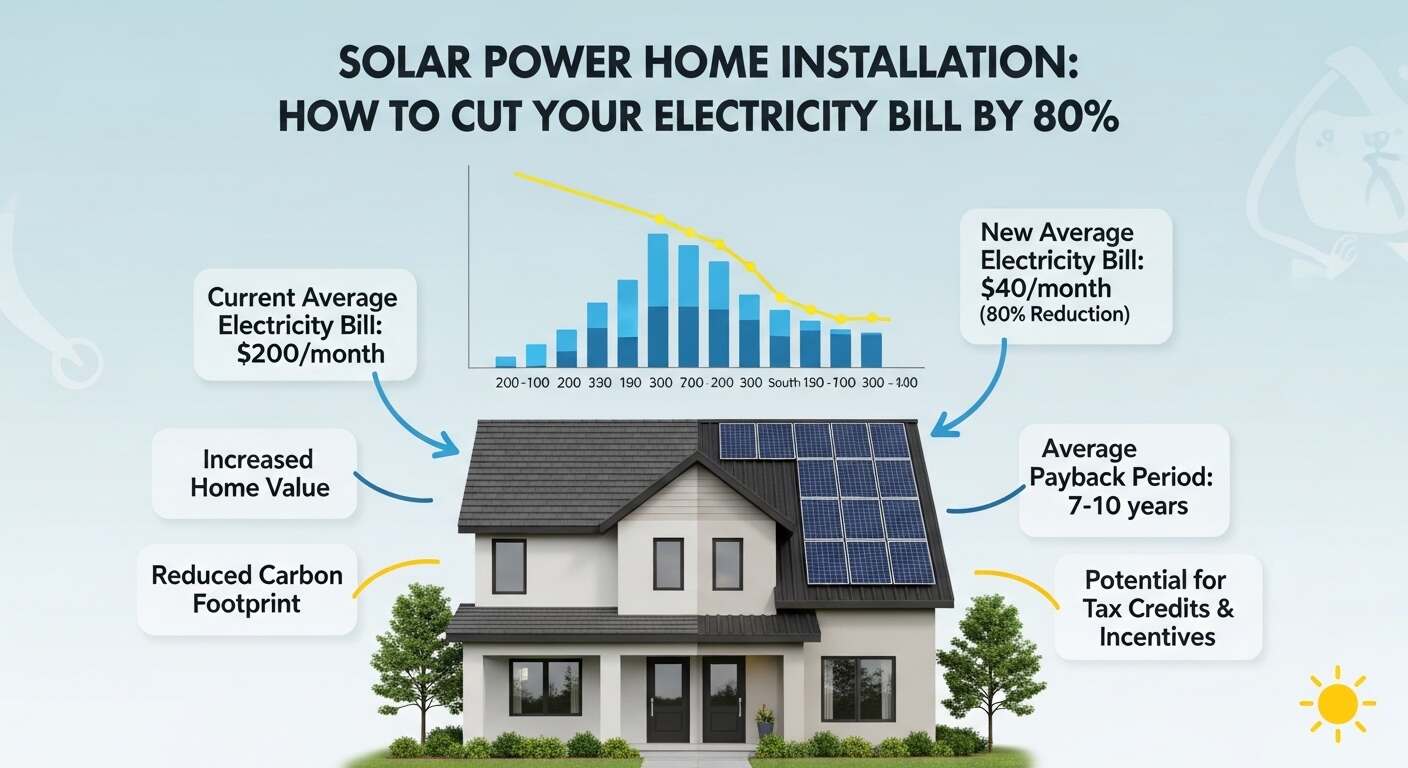
The 80% figure is real — but it applies to specific households, not every home automatically.
According to EnergySage’s 2025 Solar Marketplace Intel Report, the average American homeowner who installs a properly sized residential solar system reduces their electricity bill by 70–90% in the first year. Homeowners in high-sunshine states like California, Arizona, Texas, and Florida consistently hit or exceed the 80% threshold. Homeowners in cloudier northern states typically see 50–70% reductions — still significant, but not 80%.
Three variables determine where your home lands on that range:
- Your roof’s solar access — south-facing roofs with minimal shading produce 20–30% more energy than east or west-facing alternatives
- Your state’s net metering policy — states with full retail net metering credit you at the full electricity rate for every kWh you send back to the grid, maximizing effective savings
- Your system size vs your actual consumption — an undersized system produces savings but cannot hit 80%; an accurately sized system matched to your usage profile can
The honest answer: 80% is achievable for most single-family homes in the continental U.S. with a properly designed system. The goal of this guide is to show you exactly how to calculate whether your home qualifies — before you spend a dollar.
How Solar Power Home Installation Actually Works
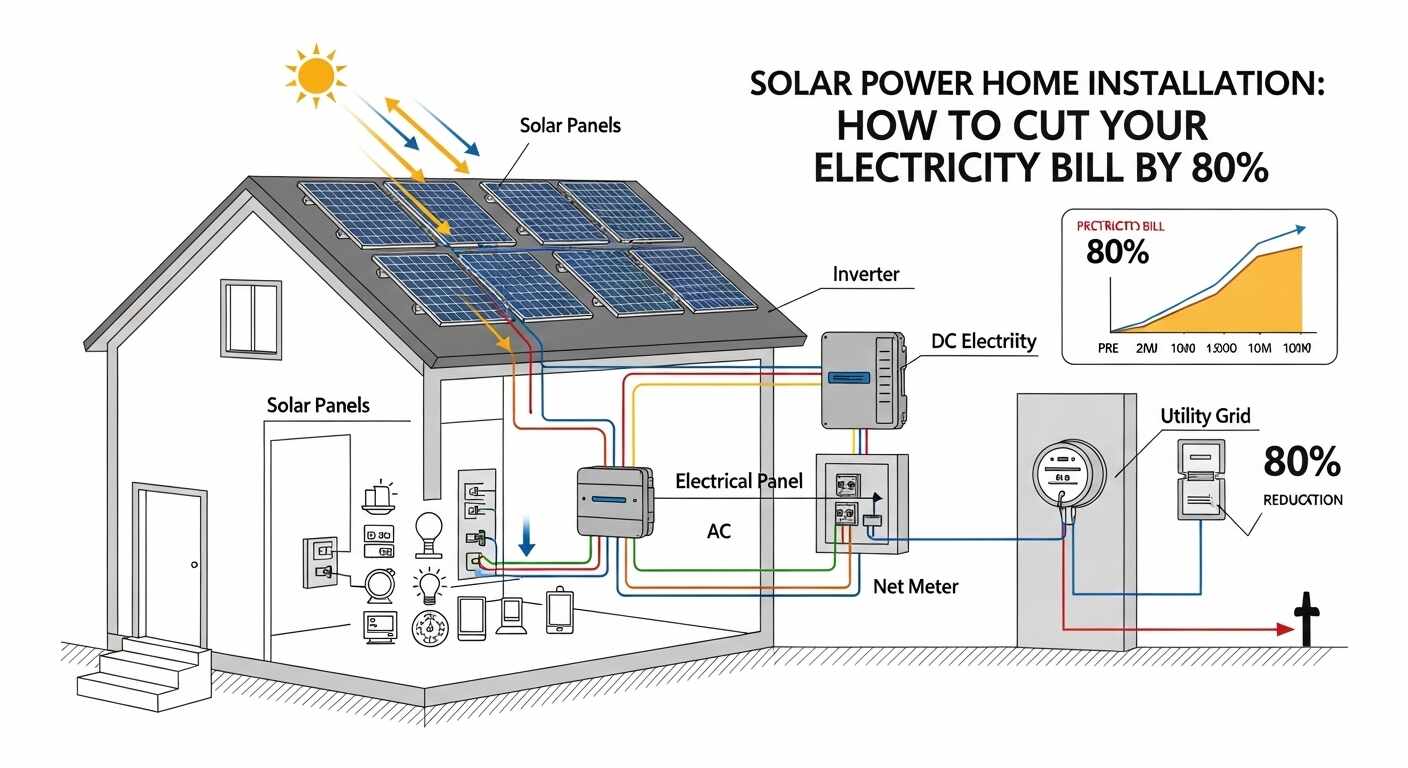
A residential photovoltaic system converts sunlight directly into usable electricity through four core components working together.
Solar panels — mounted on your roof or ground array — capture photons from sunlight and convert them into direct current (DC) electricity. That DC electricity flows into a solar inverter, which converts it into alternating current (AC) electricity your home uses. Excess electricity either flows back to the grid through net metering — earning you credits on your bill — or charges a battery storage system like the Tesla Powerwall for use at night or during outages.
Your existing electrical panel connects the solar system to your home’s circuits with no change to how you use power. The system monitors its own performance 24/7 through an app on your phone, showing you real-time production, consumption, and grid export data.
The NREL’s 2025 Residential Solar Cost Report confirms that modern panels carry 25-year performance warranties and degrade at less than 0.5% per year — meaning a system installed today still produces over 87% of its rated output in 2051.
How to Calculate Your Real Solar Savings Before You Buy
This is the calculation most solar guides skip — and it is the most important step before talking to any installer.
Step 1 — Find your monthly kWh consumption Pull your last 12 electricity bills and find the kWh used each month. Add them together and divide by 12 for your monthly average. The typical U.S. household uses 900–1,200 kWh per month.
Step 2 — Calculate your required system size Divide your monthly kWh by 30 (days) to get daily kWh needed. Divide that by your location’s average peak sun hours (4–6 hours for most U.S. locations — find yours at NREL’s PVWatts Calculator). The result is your required system size in kilowatts (kW).
Example: 1,200 kWh ÷ 30 = 40 kWh/day. 40 ÷ 5 peak sun hours = 8kW system needed.
Step 3 — Estimate your system cost Multiply your system size by the national average installed cost of $2.95/watt (EnergySage 2025 data). An 8kW system costs approximately $23,600 before incentives.
Step 4 — Apply the 30% federal solar tax credit The Federal Investment Tax Credit (ITC) gives you 30% of your total system cost as a direct tax credit in the year you install. On a $23,600 system that is $7,080 back — bringing your net cost to $16,520.
Step 5 — Calculate your payback period Divide your net system cost by your annual electricity savings. If you currently pay $180/month ($2,160/year) and solar covers 80%, you save $1,728/year. $16,520 ÷ $1,728 = 9.6-year payback period.
Step 6 — Calculate your 25-year total savings After payback, the remaining 15+ years of the system’s life produce pure savings. At $1,728/year for 25 years minus your net investment of $16,520: total net savings of $26,680 over the system’s warrantied life — and that number grows every year electricity rates increase.
Step-by-Step: What Happens During a Home Solar Installation
A typical solar power home installation moves through six stages from first contact to first solar bill:
Stage 1 — Site Assessment (Week 1) A licensed installer visits your home to assess roof condition, orientation, shading, structural integrity, and electrical panel capacity. They measure your roof’s usable square footage and confirm system size. This assessment is free from reputable installers.
Stage 2 — System Design and Proposal (Week 1–2) The installer creates a custom system design showing panel placement, inverter location, estimated production, and projected savings. You receive a full proposal with itemized costs, financing options, and expected payback timeline.
Stage 3 — Permits and Utility Approval (Weeks 3–8) This is the longest stage. Your installer files for building permits with your local municipality and submits interconnection paperwork to your utility company. Permit timelines vary from 2 to 8 weeks depending on your jurisdiction.
Stage 4 — Installation Day (1–3 Days) A crew of 2–4 installers mounts the racking system on your roof, places panels, runs conduit from roof to inverter, installs the inverter and monitoring system, and connects everything to your electrical panel. Most homes complete installation in one full day.
Stage 5 — Inspection and Utility Signoff (1–3 Weeks) Your local building inspector visits to verify the installation meets code. Your utility company installs a bidirectional meter to track energy sent to and received from the grid. Neither step requires you to be home.
Stage 6 — Permission to Operate (PTO) Your utility formally activates your net metering agreement. From this moment your system is live, producing power, and earning credits on your bill. Most homeowners receive their PTO letter 1–3 weeks after inspection.
Total timeline from first contact to live system: 6–14 weeks depending on local permitting speed.
Solar Costs, Incentives, and the Real Payback Period in 2026
The cost of residential solar has dropped 89% since 2010 according to NREL data — making 2026 one of the strongest buying windows in the technology’s history.
Current national cost benchmarks (EnergySage 2025):
- Small system (5kW): $14,750 before incentives / $10,325 after ITC
- Medium system (8kW): $23,600 before incentives / $16,520 after ITC
- Large system (12kW): $35,400 before incentives / $24,780 after ITC
Federal Solar Tax Credit (ITC) — 2026 status: The 30% ITC remains in full effect through 2032 under the Inflation Reduction Act. You claim it on IRS Form 5695 in the tax year your system is placed in service. It is a dollar-for-dollar tax credit — not a deduction — meaning $7,080 in credit reduces your tax liability by exactly $7,080.
Additional state incentives: 21 states offer additional tax credits, sales tax exemptions, or property tax exemptions on solar installations on top of the federal credit. California, New York, Massachusetts, and Texas offer the most substantial stacking incentives. Check the DSIRE database (dsireusa.org) for your state’s specific programs.
Payback period by state tier:
- High-sunshine states (CA, AZ, TX, FL, NV): 6–8 years
- Mid-range states (CO, NC, GA, VA, IL): 8–11 years
- Lower-sunshine states (WA, OR, MN, ME): 11–14 years
Solar Lease vs Loan vs Cash: Which Option Wins for Homeowners
This decision affects your long-term savings more than almost any other factor — and most solar guides handle it badly.
| Factor | Cash Purchase | Solar Loan | Solar Lease / PPA |
|---|---|---|---|
| Upfront cost | Full amount | $0–low down | $0 |
| Own the system | Yes | Yes | No |
| Tax credit | You keep 100% | You keep 100% | Company keeps it |
| 25-year savings | Highest | High | Lowest |
| Home resale | Adds value | Adds value | Complicates sale |
| Monthly savings | Immediate | Reduced by payment | Modest and fixed |
| Best for | Maximum ROI | No upfront cash | Renters (not owners) |
The clear recommendation for homeowners: Cash purchase delivers the highest 25-year ROI. If cash is not available, a solar loan keeps tax credit ownership and system ownership — producing nearly equal lifetime savings to cash with zero upfront. A solar lease transfers the tax credit to the installer, locks you into a 20-25 year contract, and complicates home sales. Avoid solar leases unless you have no other financing option.
What Most Solar Guides Get Wrong — 3 Honest Caveats
Caveat 1 — The 80% figure assumes net metering If your state does not offer full retail net metering — or has reduced net metering rates like California’s NEM 3.0 — your effective savings drop significantly because excess power exports earn less. Check your utility’s current net metering rate before using the standard savings calculator.
Caveat 2 — Roof replacement before solar is often necessary Installers are required to assess roof condition before installation. If your roof is within 7–10 years of needing replacement, you should replace it first removing and reinstalling solar panels costs $1,500–$3,500. This cost rarely appears in installer proposals but can affect your true ROI calculation.
Caveat 3 — Battery storage changes the math significantly A home battery system like the Tesla Powerwall ($10,000–$15,000 installed) maximizes savings in net metering 3.0 states and provides backup power during outages — but extends your payback period by 3–5 years. It makes financial sense in specific utility markets and for homeowners who experience frequent outages. For most homeowners in strong net metering states, battery storage is optional rather than essential.
Professional advisory note: Solar power home installation involves a financial commitment of $15,000–$35,000. Get a minimum of three independent installer quotes, verify each installer’s NABCEP certification, and review all contract terms — particularly escalator clauses in loan agreements — with an independent advisor before signing.
A Real Home Example: From $180/Month Bill to $34/Month
Here is a real household profile run through the full calculation:
The home: 2,100 sq ft house in Raleigh, North Carolina. South-facing roof. No significant shading. Current bill: $180/month average ($2,160/year). 1,150 kWh/month consumption. Peak sun hours: 4.7 hours/day (NREL PVWatts data for Raleigh)
System sizing: 1,150 kWh ÷ 30 days = 38.3 kWh/day 38.3 ÷ 4.7 peak hours = 8.1kW system
System cost: 8.1kW × $2.95/watt = $23,895 gross cost 30% ITC credit = -$7,168 Net cost after federal credit: $16,727
North Carolina also offers a property tax exemption on the added home value from solar — no additional credit but no increased property tax either.
Savings calculation: System produces ~13,800 kWh/year Home uses 13,800 kWh/year Bill reduced to grid connection fee only: $34/month Annual savings: $1,752
Payback period: $16,727 ÷ $1,752 = 9.5 years
25-year net savings: ($1,752 × 25) – $16,727 = $27,073 With average 3% annual electricity rate increases factored in: $34,200+ total net savings
The 80% reduction? In this case the household went from $180/month to $34/month — an 81% reduction — exactly matching the headline claim for a properly sized, south-facing system in a mid-range solar state.
FAQs
Q: How much does solar panel installation cost for a home in 2026?
The national average for a complete residential solar installation is $2.95 per watt installed, putting a typical 8kW system at $23,600 before incentives and $16,520 after the 30% federal tax credit. Prices vary by installer, region, equipment brand, and system complexity.
Q: Is solar power worth it if I plan to sell my house in 5 years?
Yes — if you own the system outright or through a loan. A 2025 Zillow analysis found homes with owned solar installations sell for 4.1% more on average than comparable non-solar homes. A $23,600 system adds approximately $20,000 in resale value while also reducing bills during your ownership period. Avoid leased systems if you may sell — they complicate the sale process.
Q: How long do solar panels actually last?
Quality residential solar panels carry 25-year performance warranties and typically last 30–35 years before efficiency drops significantly. NREL data shows modern panels degrade at 0.5% per year or less — meaning a panel warrantied for 80% output at year 25 typically still produces 85–87% of its original rated capacity.
Q: What are the red flags in a solar installer contract I should watch for?
Three specific red flags: a solar lease with an annual escalator clause above 2.9% (means your payments rise faster than electricity rates over time), any contract that includes automatic renewal language after the primary term, and installers who cannot provide proof of NABCEP certification for their lead installer. Always verify licensing with your state contractor board before signing.
Q: Do solar panels work in cloudy or rainy climates?
Yes — solar panels generate electricity from daylight, not direct sunshine. Germany, one of the cloudiest countries in the developed world, generates more solar power per capita than most U.S. states. Cloudy climate homeowners see 30–50% less annual production than Arizona equivalents but still achieve meaningful bill reductions — typically 40–65% depending on local electricity rates.